How to Prepare for Norskprøven - Complete Guide
Preparing for Norskprøven can feel overwhelming, especially when you are not sure what to study, which level to choose or what to expect on test day.
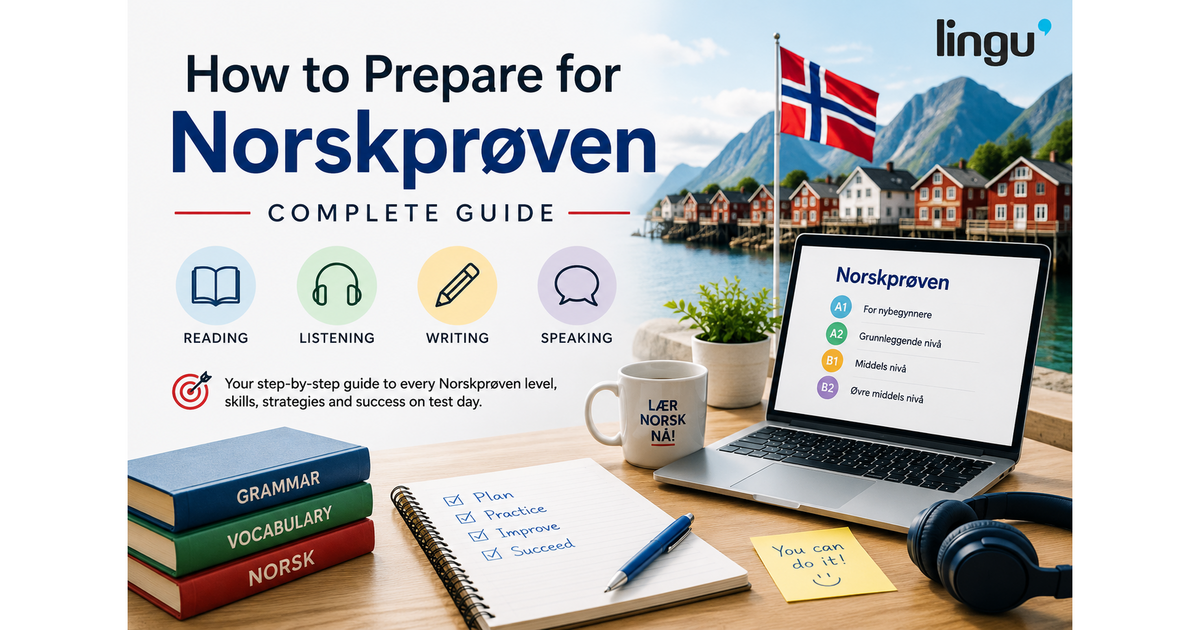
The most effective way to prepare for Norskprøven is to understand how the test works and practise the four language skills it assesses: reading, listening, writing and speaking. Rather than memorising answers, you need to develop the Norwegian skills required at your target level and become familiar with the types of tasks you may encounter.
This complete guide explains how to prepare for Norskprøven, what the different levels mean, how each part of the test works and how to build an effective study plan before your exam.
What is Norskprøven?
Norskprøven is the official Norwegian language test used to assess Norwegian language proficiency from A1 to B2.
The test has four separate sections:
-
Reading - leseprøven
-
Listening - lytteprøven
-
Writing - skriveprøven
-
Speaking - muntlig prøve
The test measures your ability to understand and use Norwegian in situations relevant to everyday life, education and work.
Importantly, there is no fixed curriculum that you have to memorise for Norskprøven. The test measures your Norwegian language proficiency, not how much you know about particular subjects.
You can choose which of the four sections you want to take. This also means that individual sections can be taken again later if you need a different result.
What levels are available in Norskprøven?
Norskprøven assesses Norwegian from A1 to B2 according to the Common European Framework of Reference for Languages (CEFR).
The four levels represent progressively stronger language ability:
-
A1 - Beginner - At A1, you can understand and use very basic Norwegian in familiar everyday situations.
-
A2 - Elementary - At A2, you can communicate about familiar topics and understand relatively simple Norwegian connected to everyday life.
-
B1 - Intermediate - At B1, you can communicate independently in many everyday, work and social situations. You can explain experiences and opinions and understand the main points of clear Norwegian on familiar subjects.
-
B2 - Upper intermediate - At B2, you can understand and communicate about more complex subjects, express and support opinions and use Norwegian with considerably greater flexibility and precision.
Your goal should not simply be to choose the highest possible level. Your preparation should focus on the level you realistically need and the language skills required to demonstrate that level.
How does Norskprøven work?
Norskprøven consists of four separate tests covering reading, listening, writing and speaking.
The different sections assess different skills, which is why good Norskprøven preparation should not consist of only learning grammar or completing practice tests. You need to develop each language skill individually while also improving your overall Norwegian.
Before registering, it is important to understand the test structure and which level you should choose. You can find current information about registration, levels and the different sections directly from HK-dir's official Norskprøven information.
What is the best way to prepare for Norskprøven?
The best way to prepare for Norskprøven is to combine regular Norwegian language practice with targeted preparation for the individual test sections.
Your preparation should include:
-
Understanding the structure of Norskprøven
-
Identifying the level you need
-
Understanding what is expected at that level
-
Practising reading regularly
-
Listening to Norwegian regularly
-
Completing writing tasks
-
Speaking Norwegian frequently
-
Developing level-appropriate vocabulary and grammar
-
Practising different Norskprøven-style tasks
-
Identifying your weaker areas and working specifically on them
One of the most important principles is consistency. Studying Norwegian regularly over time is generally much more useful than trying to prepare intensively during the final few days before the test.
How to prepare for the Norskprøven reading test
The reading section tests how well you understand written Norwegian.
A common preparation mistake is simply reading Norwegian texts without checking how much you actually understand.
Instead, practise reading actively.
Read different types of Norwegian content, such as:
-
News and short articles
-
Emails and messages
-
Public information
-
Workplace communication
-
Advertisements
-
Instructions
-
Everyday digital content
-
Longer texts appropriate for your level
After reading, ask yourself:
-
What is the main message?
-
Which details are important?
-
What is the writer trying to communicate?
-
Which words can I understand from context?
You do not necessarily need to understand every individual word to understand a text.
It is also useful to practise reading under time pressure and work with different task formats so that processing Norwegian quickly becomes increasingly natural.
Lingu's Preparation for Norskprøven programme provides structured reading practice at A1, A2, B1 and B2 levels alongside vocabulary, grammar and other skills relevant to your target level.
How to prepare for the Norskprøven listening test
Listening can be challenging because spoken Norwegian happens in real time. You cannot control how quickly another person speaks, and authentic Norwegian can sound very different from carefully pronounced classroom Norwegian.
The best way to improve listening comprehension is to expose yourself to Norwegian regularly.
Listen to:
-
Norwegian conversations
-
Podcasts (here we highly recommend the Norskpodden by Lingu)
-
News
-
Videos
-
Radio
-
Interviews
-
Workplace conversations
-
Everyday spoken Norwegian
Try listening once without stopping.
Ask yourself what you understood.
Then listen again and concentrate on the information you missed.
Do not train yourself to understand Norwegian only when every word is perfectly clear. During real communication, you often need to understand the overall meaning even when you miss individual words.
Regular listening practice also helps you become more familiar with Norwegian pronunciation, rhythm and different ways of speaking.
Preparation for Norskprøven includes dedicated listening practice adapted to A1, A2, B1 and B2.
How to prepare for the Norskprøven writing test
To improve your Norwegian writing, you need to write.
Studying vocabulary and grammar is important, but recognising grammatical rules is different from being able to use them when producing your own text.
Practise writing about a variety of familiar topics and situations.
Depending on your level, this may involve communicating information, describing experiences, expressing opinions, explaining ideas or supporting an argument.
When reviewing your writing, pay attention to:
-
Whether you answered the task
-
Organisation and coherence
-
Vocabulary
-
Grammar
-
Sentence structure
-
Spelling
-
Whether your language is appropriate for your target level
One serious mistake to avoid is trying to make your Norwegian unnecessarily complicated.
A clear, accurate sentence that communicates exactly what you mean is usually more useful than an extremely complicated sentence filled with mistakes.
As you progress towards B1 and B2, however, you should gradually demonstrate a wider vocabulary, greater grammatical control and the ability to develop and connect your ideas.
Lingu's Preparation for Norskprøven programme includes writing practice together with personalised feedback from an AI tutor and a teacher, helping you understand your strengths and what you should work on next.
How to prepare for the oral Norskprøven
The oral Norskprøven assesses your ability to communicate in spoken Norwegian.
The oral test requires you to speak about different topics both independently and together with another person. This means that simply memorising model answers is not an effective preparation strategy. You need to practise thinking and responding in Norwegian.
Practise:
-
Talking about familiar topics
-
Describing experiences
-
Expressing opinions
-
Explaining why you think something
-
Agreeing and disagreeing
-
Giving reasons and examples
-
Responding to unexpected questions
-
Continuing a conversation
-
Speaking without preparing every sentence in advance
One particularly useful technique is to give yourself a random everyday topic and start speaking aloud immediately.
Do not write your complete answer first. The objective is to train your brain to retrieve vocabulary, build sentences and communicate ideas in real time.
For dedicated oral Norskprøven preparation, Lingu offers Muntlig, an AI-powered speaking tool that simulates realistic oral Norskprøven situations. An AI examiner asks exam-style questions, listens to your responses and provides personalised feedback, allowing you to practise oral Norwegian independently and repeatedly.
What do examiners assess in Norskprøven?
Norskprøven measures your ability to use Norwegian, rather than your knowledge about the topics appearing in the test.
This distinction is extremely important.
You are not expected to be an expert on work, education, family life, technology, health or another subject simply because a task relates to that topic.
The subject provides a context in which you demonstrate your Norwegian.
For writing and speaking, assessment looks at different aspects of your language performance appropriate to the level, including how effectively you complete the task and the quality and range of the language you use.
For the oral test, important language areas include fluency, pronunciation, vocabulary and grammar.
Therefore, when preparing, do not spend your time trying to predict the exact questions that will appear.
Develop the language skills that allow you to respond to many different questions.
How do I choose the right Norskprøven level?
Choose your target level based on two things:
The level you currently have - and - the level you need
These are not always the same.
For example, you may need B1 for a particular purpose but currently have Norwegian closer to A2. In that situation, practising B1 exam questions alone will not automatically make your Norwegian B1. You may first need to develop your general language skills.
Before beginning intensive test preparation, identify the gap between your current ability and your required result. If the gap is significant, combine Norskprøven preparation with broader Norwegian language learning.
How long should I prepare for Norskprøven?
There is no single preparation period that works for everyone.
Someone whose Norwegian is already comfortably at their target level may primarily need to become familiar with the test and practise specific skills.
Someone who needs to progress from A2 to B1, for example, has a different task. They are not simply preparing for an exam - they are developing their Norwegian to a higher proficiency level.
Your preparation time therefore depends on:
-
Your current Norwegian level
-
Your target level
-
How frequently you use Norwegian
-
Your reading ability
-
Your listening ability
-
Your writing ability
-
Your speaking ability
-
How much time you can study consistently
-
Which areas require the most improvement
Do not measure preparation only in weeks.
Measure it in skills. Ask yourself:
-
Can I understand Norwegian texts at my target level?
-
Can I follow spoken Norwegian?
-
Can I write effectively at that level?
-
Can I speak spontaneously and explain my ideas?
Those questions tell you much more about your readiness than the number of weeks you have studied.
A practical Norskprøven study strategy
A strong preparation plan should include all the skills you need rather than concentrating exclusively on your favourite or strongest area.
During a typical week, combine reading, listening, writing and speaking practice.
The exact schedule can vary, but the principle is simple: Use Norwegian actively and regularly.
If listening is your weakest area, give it additional attention. If you understand Norwegian well but freeze when you have to speak, increase your speaking practice.
If writing is holding you back, write more frequently and use feedback to identify recurring problems.
Your preparation should become increasingly targeted as the exam approaches. Instead of repeatedly practising things you already do well, spend more time on the skills that are preventing you from reaching your target level.
If you need broader language development rather than only exam practice, a structured Norwegian course such as Lingu's Fast-Track Norwegian can help you develop reading, listening, writing and speaking through teacher-led learning alongside independent practice.
Common Norskprøven preparation mistakes
1. Memorising answers
You cannot know exactly which questions or topics you will receive. Memorising complete responses can therefore leave you unprepared when the task changes. Learn to produce Norwegian, not recite Norwegian.
2. Studying grammar without using it
Grammar exercises can be valuable, but knowing a rule does not automatically mean you can use it while writing or speaking. Apply grammar through real communication.
3. Avoiding speaking until your Norwegian is ‘good enough’
Speaking improves through speaking. Waiting until you feel completely confident before you start practising usually delays the very practice that creates confidence.
4. Ignoring your weakest skill
It is tempting to spend time doing what you already do well. Effective preparation requires the opposite. Identify your weakest areas and work on them deliberately.
5. Practising only exam questions
Norskprøven is a language proficiency test, not a knowledge test based on a fixed curriculum. Exam-style practice is useful because it helps you understand the format, but you also need genuine language development through reading, listening, writing and speaking.
6. Trying to predict the exact exam topics
You cannot know exactly what will appear. Prepare to communicate about a broad range of familiar subjects instead.
7. Starting too late
Cramming can help you remember information. It cannot instantly create fluency, listening comprehension or spontaneous speaking ability. Language development requires repeated exposure and practice.
What should I do in the final weeks before Norskprøven?
As your exam approaches, gradually shift your preparation from general language development towards more focused test practice.
-
Make sure you understand the format of every section you are taking.
-
Practise different task types.
-
Continue working on your weakest skills.
-
For writing, complete full tasks and review your recurring mistakes.
-
For speaking, practise responding without knowing the question beforehand.
-
For reading and listening, practise understanding information efficiently rather than translating everything into your first language.
-
Use the Lingu’s learning tools to become familiar with the task types:
Preparation for the Norwegian Language Test for preparing for the writing, reading and listening part of Norskprøven.
Muntlig - practice for the oral Norwegian exam with an AI examiner that listens and responds
Remember that these are examples of the types of tasks used in Norskprøven, not questions you should expect to receive on your own test.
Most importantly, continue using Norwegian. The final weeks are not the time to stop communicating and spend all your time memorising lists.
How can I prepare for all four parts of Norskprøven online?
You can prepare for all four language areas online, but different skills benefit from different forms of practice.
Lingu provides two complementary Norskprøven preparation resources.
Preparation for Norskprøven - Reading, listening and writing
Preparation for Norskprøven provides structured digital practice for:
-
Reading
-
Listening
-
Writing
-
Vocabulary
-
Grammar
-
Common topics
-
Pronunciation
-
Assessment criteria
The programme is available at A1, A2, B1 and B2 levels. You receive six months of access and can study independently at your own pace, with personalised feedback from both an AI tutor and a teacher.
Muntlig - Oral Norskprøven preparation
Muntlig is designed specifically for the speaking section of Norskprøven.
Instead of only reading example questions, you practise speaking aloud with an AI examiner in realistic exam-style situations. You can practise repeatedly and receive personalised feedback on important areas of your spoken Norwegian, including fluency, pronunciation, vocabulary and grammar.
Muntlig is designed for learners preparing for the A2-B1 and B1-B2 oral Norskprøven and can be used independently or alongside a Norwegian course. Using Preparation for Norskprøven together with Muntlig gives you dedicated practice across all four main areas: reading, listening, writing and speaking.
Do I need Norskprøven for permanent residence in Norway?
Norskprøven can be relevant if you are applying for permanent residence in Norway, but it is important to check the current requirements rather than relying on older information online.
Under the rules that came into effect on 1 September 2025, applicants aged 18 to 67 generally need to have passed an oral Norwegian test at A2 level or higher and a social studies test in a language they understand. Some exemptions and rules depend on individual circumstances, so always check UDI's current Norwegian language requirements for permanent residence before applying.
What Norskprøven level do I need for Norwegian citizenship?
For many applicants aged 18 to 67, the general requirement for Norwegian citizenship is to have passed an oral Norwegian test at B1 level or higher and the applicable citizenship or social studies test.
Different requirements and exemptions can apply depending on your circumstances. Because citizenship requirements are legal requirements and can change, always check UDI's current Norwegian citizenship requirements for your individual situation.
Is Norskprøven difficult?
Norskprøven can be challenging, but difficulty depends largely on the relationship between your current Norwegian ability and the level you are trying to achieve.
If your Norwegian is genuinely at B1 level, preparing for a B1 result is very different from trying to achieve B1 while your current skills are still around A1 or A2.
This is why effective Norskprøven preparation has two components:
Develop your Norwegian to the required level - then- learn how to demonstrate those skills effectively in the test.
Exam preparation cannot replace language ability, but good preparation can help you understand what is expected, practise relevant skills and avoid walking into the test unfamiliar with its format.
Can I prepare for Norskprøven without taking a Norwegian course?
Yes. You do not have to attend a Norwegian course simply to prepare for Norskprøven.
HK-dir explains that Norskprøven does not have a fixed curriculum. The test assesses your Norwegian language proficiency, so the most important preparation is developing and practising your Norwegian.
Whether independent preparation is the right choice depends on your current ability.
If you are already close to your required level, structured self-study and targeted test preparation may be sufficient.
If you need significant language development, a Norwegian course can provide broader teaching and structured progression before or alongside exam-specific preparation.
How do I know when I am ready for Norskprøven?
Being ready does not mean speaking perfect Norwegian.
-
Ask whether you can consistently perform the skills expected at your target level.
-
Can you understand appropriate written texts without translating every sentence?
-
Can you understand the main information in spoken Norwegian?
-
Can you write independently about different topics?
-
Can you speak without memorising your entire response?
-
Can you explain your opinions and respond when the conversation develops unexpectedly?
-
Can you recognise your own mistakes and continue communicating?
If the answer is increasingly yes, you are moving in the right direction.
Final advice: How to prepare effectively for Norskprøven
The most effective Norskprøven preparation is not about discovering a secret list of questions. It is about becoming better at using Norwegian.
Understand the test. Know your target level. Practise the task types. But above all, read Norwegian, listen to Norwegian, write Norwegian and speak Norwegian.
Work consistently rather than cramming. Use feedback to identify your weaknesses. Practise unfamiliar situations rather than memorising perfect answers. And as the exam approaches, make your preparation increasingly similar to the situations in which you will need to demonstrate your Norwegian.
For structured preparation, Lingu's Preparation for Norskprøven programme helps you work specifically with reading, listening and writing at A1, A2, B1 or B2, with feedback from an AI tutor and a teacher.
For speaking, Muntlig gives you dedicated oral Norskprøven practice with an AI examiner, allowing you to practise realistic speaking situations repeatedly before the real test.
Together, these resources allow you to prepare for all four main language areas while studying online and at your own pace.
Frequently asked questions about preparing for Norskprøven
What is the best way to prepare for Norskprøven?
The best way to prepare is to combine regular Norwegian language practice with targeted preparation for reading, listening, writing and speaking. Understand the test format, know your target level, practise realistic tasks and spend additional time improving your weakest skills.
Can I prepare for Norskprøven online?
Yes. Reading, listening, writing and speaking can all be practised online. Lingu offers Preparation for Norskprøven for reading, listening and writing and Muntlig for dedicated oral Norskprøven practice.
How long should I study for Norskprøven?
There is no fixed preparation period. The amount of time you need depends primarily on your current Norwegian level, your target level and the particular language skills you need to improve.
Can I pass Norskprøven through self-study?
It is possible to prepare independently, particularly if your Norwegian is already close to your target level. However, learners who still need significant language development may benefit from combining independent exam preparation with a structured Norwegian course.
Should I memorise answers for the oral Norskprøven?
No. Memorising complete answers can make it difficult to respond when you receive an unfamiliar question. Practise expressing ideas spontaneously, explaining opinions and responding to different topics instead.
What should I practise most before Norskprøven?
Practise all the sections you plan to take, but give additional attention to your weakest skills. Your preparation should include reading, listening, writing or speaking as relevant, together with vocabulary and grammar appropriate for your target level.
What Norwegian level is required for permanent residence?
Under the general rules applying from 1 September 2025, applicants aged 18 to 67 generally need to have passed an oral Norwegian test at A2 or higher. Exemptions and other rules can apply, so check your individual requirements with UDI.
What Norwegian level is required for Norwegian citizenship?
For many applicants aged 18 to 67, the general requirement is a passed oral Norwegian test at B1 or higher. Different rules or exemptions can apply, so always check UDI's current citizenship requirements for your situation.
Does Lingu offer preparation for the whole Norskprøven?
Yes. Lingu's Preparation for Norskprøven focuses on reading, listening and writing at A1, A2, B1 and B2. Muntlig provides dedicated AI-powered preparation for the oral Norskprøven at A2-B1 and B1-B2.
Can any Norskprøven preparation programme guarantee that I will pass?
No. No responsible preparation programme can guarantee a particular result. Your result depends on the Norwegian language skills you demonstrate during the test. Good preparation can help you develop those skills, understand what is expected and arrive at the test better prepared.
Чи хотіли б ви більше вивчати норвезьку?
Зареєструйтеся сьогодні та вивчіть норвезьку за допомогою нашого ігрового онлайн-курсу «Samanehs reise» від початкового рівня до вільного мовця!
NOK 415 per month