How to Prepare for the Oral Norskprøven - Complete Guide
In this guide, you will learn how the oral Norskprøven works, which level to choose, what the examiners assess, how to improve your fluency, vocabulary, grammar and pronunciation, what to do when you do not know how to answer and how to practise effectively before your exam.
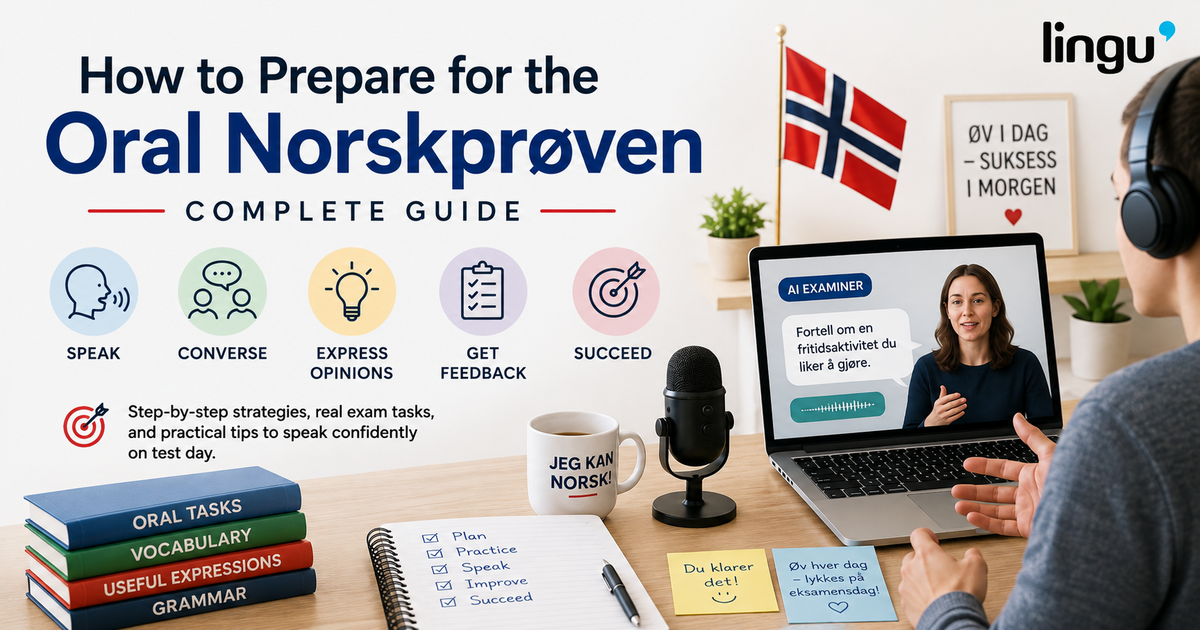
The best way to prepare for the oral Norskprøven is to speak Norwegian regularly and practise situations that resemble the real oral test.
Knowing vocabulary and grammar is important, but the oral Norskprøven tests whether you can actually use Norwegian in real time. You need to understand a task, decide what you want to say, find the right words, build sentences, pronounce them clearly and keep communicating - often without much time to prepare.
That is why effective preparation should include much more than reading example answers.
You need to speak.
What is the oral Norskprøven?
The oral Norskprøven - muntlig prøve - is the speaking part of the official Norwegian Language Test.
According to HK-dir's official information about the oral Norskprøven, the oral test measures how well you speak Norwegian. You normally take the test together with another candidate, and you complete both individual speaking tasks and a conversation task.
The oral test assesses your ability to communicate in Norwegian rather than your specialist knowledge about particular subjects.
You therefore do not need to know everything about a topic.
You need to demonstrate that you can communicate about it in Norwegian.
What levels can I take in the oral Norskprøven?
When registering for the oral Norskprøven, you choose between three test levels:
-
A1-A2
-
A2-B1
-
B1-B2
A1-A2 is the easiest oral test level, A2-B1 is the intermediate option and B1-B2 is the most advanced of the three.
Importantly, the level of the test you register for and the result you ultimately receive are not necessarily the same.
HK-dir explains that you can receive a result below the level you registered for. You may also demonstrate a higher level. If the examiner believes you may be capable of achieving a higher result, you can be given an additional question from the level above.
You can read more about choosing a level on HK-dir's official oral Norskprøven page.
If you are taking Norwegian classes, it can also be useful to discuss the appropriate test level with your teacher.
What is the difference between A2-B1 and B1-B2 oral Norskprøven?
Both tests assess spoken Norwegian, but the expectations increase as the level becomes higher.
At A2-B1, you need to communicate about familiar subjects, describe experiences and situations, participate in conversation and express your opinions with enough language to make yourself understood.
At B1-B2, you are expected to communicate with greater independence, flexibility and precision. You need to develop your ideas more fully, use a broader vocabulary and demonstrate stronger control of spoken Norwegian.
At the higher level, simply stating an opinion is often not enough.
You need to be increasingly capable of explaining why you think something, developing your argument, giving relevant examples and responding to another person's viewpoint.
This distinction is important when preparing.
Do not simply practise speaking for longer.
Practise speaking at the level you want to demonstrate.
What happens during the oral Norskprøven?
The official oral Norskprøven takes less than half an hour and is normally taken together with another candidate.
During the test, you will speak both independently and interact with another person.
The tasks vary according to the test level.
This means that your preparation should include both:
Individual speaking
and
Interactive conversation.
Practising only prepared monologues is not enough. You also need experience listening to another person, reacting to what they say and continuing a conversation naturally.
You can find the current test structure directly on HK-dir's official oral communication test page.
What types of tasks can appear in the oral Norskprøven?
The exact tasks depend on the level you take.
Depending on your level, you may need to:
-
Introduce yourself
-
Describe a picture
-
Talk about an everyday topic
-
Participate in a conversation
-
Exchange information or viewpoints
-
Express an opinion
-
Explain your reasoning
-
Discuss a topic with another candidate
-
Develop and justify your views
At higher levels, you need to demonstrate increasingly sophisticated communication and a greater ability to explain and support what you think.
The exact topic you receive cannot be predicted.
That is precisely why practising many different subjects is more effective than memorising a small number of perfect answers.
Lingu gives you the opportunity to experience and practise a realistic exam situation with Muntlig, an AI-powered exam practice tool designed to simulate the real oral exam experience. Use these to understand, practice and get the feeling of the types of tasks you may encounter rather than trying to memorise particular answers.
What topics can appear in the oral Norskprøven?
The oral Norskprøven uses subjects that adults can reasonably be expected to talk about.
HK-dir gives examples such as family, school and work.
Other preparation topics can include areas such as:
-
Family and relationships
-
Work
-
Education
-
Everyday life
-
Leisure and hobbies
-
Health and lifestyle
-
Technology
-
Travel and transport
-
The environment
-
Society
-
Living in Norway
But trying to predict the exact topic is not a good preparation strategy.Instead, practise speaking about a wide range of familiar subjects.
This is where Lingu's Muntlig AI exam simulation tool can make a real difference. It allows you to practise in a realistic exam-like setting, experience what it feels like to respond under exam conditions, and receive personalised feedback on your performance. By practising repeatedly with different tasks and topics, you can build confidence, improve your speaking skills, and become better prepared for the real oral Norskprøven.
The goal is to develop enough flexibility that when you receive an unfamiliar question, you can still formulate an answer.
What do examiners assess in the oral Norskprøven?
According to HK-dir, the oral test assesses whether you can give a comprehensible answer to the task and evaluates important aspects of your spoken Norwegian, including:
-
Fluency
-
Pronunciation
-
Vocabulary
-
Grammar
You can read the official explanation of the assessment directly on HK-dir's oral Norskprøven page.
These areas work together.
Excellent grammar alone is not enough if you cannot communicate your ideas. A large vocabulary is less useful if you cannot retrieve the words when you need them. Good pronunciation does not require sounding exactly like a native Norwegian speaker. What matters is that your speech is understandable and allows you to communicate effectively.
Your goal should therefore be effective spoken Norwegian, not perfection.
How can I improve my fluency before the oral Norskprøven?
Fluency develops through speaking. Many learners make the mistake of spending most of their preparation reading, completing grammar exercises or learning vocabulary and expecting their speaking ability to improve automatically. These activities can support speaking, but they cannot replace it.
You can try practicing on your own, however, practising entirely on your own can be challenging. It can be difficult to know which topics to practise, whether your answers are at the right level, or what you need to improve. This is where Lingu's Muntlig AI exam simulation tool becomes especially valuable.
Muntlig creates a highly realistic simulated oral exam experience, designed to make you feel as though you are actually sitting the Norskprøven. Instead of simply practising random speaking exercises, you are placed in an exam-like situation with realistic questions and tasks based on the types of topics you may encounter in the real oral exam. You can practise again and again across a wide range of topics, experience what it feels like to answer under exam conditions, and receive personalised AI feedback on your performance.
This combination of realistic exam practice, varied questions, repetition, and detailed feedback helps you understand what to expect, improve your speaking skills, and walk into the real Norskprøven feeling much better prepared and more confident.
How can I improve my vocabulary for the oral Norskprøven?
Do not learn vocabulary only as isolated lists.
Learn vocabulary that helps you do something in a conversation.
You need words and expressions that help you:
-
Describe
-
Compare
-
Explain
-
Give examples
-
Express opinions
-
Agree and disagree
-
Explain advantages and disadvantages
-
Talk about causes and consequences
-
Suggest solutions
-
Connect ideas
Also build vocabulary around common everyday themes.
Then use those words aloud.
A word you recognise while reading is part of your passive vocabulary. The oral Norskprøven requires you to retrieve and use vocabulary actively.
Speaking practice helps turn passive vocabulary into active vocabulary. The more often you use words and expressions in real speaking situations, the easier it becomes to access them naturally and quickly when you need them. This is also where Lingu's Muntlig AI exam simulation tool can be particularly useful. By practising realistic oral exam questions across a wide range of topics, you are encouraged to actively use your vocabulary in an exam-like situation rather than simply recognise or memorise words. You can practise repeatedly, receive personalised feedback, and gradually become more confident and spontaneous when expressing yourself in Norwegian.
How can I improve my grammar when speaking Norwegian?
Do not wait until your grammar is perfect before speaking.
Instead, use speaking itself as grammar practice.
When you notice recurring mistakes, identify them and concentrate on improving those specific areas.
For example, you might repeatedly struggle with:
-
Word order
-
Verb forms
-
Gender and articles
-
Adjective agreement
-
Prepositions
-
Subordinate clauses
-
Connecting sentences
Work on one or two recurring problems at a time.
Then deliberately use those structures in your speaking practice. The goal is not simply to know the grammatical rule. The goal is to be able to use it naturally while you are concentrating on communicating something else. Muntlig is a great tool for practising exactly this, as the realistic exam simulation encourages you to apply grammar spontaneously while answering real exam-style questions and focusing on communicating your ideas clearly.
How can I improve my Norwegian pronunciation?
The purpose of pronunciation practice is to make your Norwegian clear and understandable.
Pay attention to:
-
Norwegian vowels
-
Difficult consonant sounds
-
Word stress
-
Sentence rhythm
-
Intonation
-
Sounds that are particularly difficult because of your first language
Listening and speaking should work together. Listen carefully to Norwegian and notice how words, sounds, and sentences are actually pronounced, then repeat them aloud. Recording yourself can also be useful, as listening back may help you notice pronunciation patterns that you do not hear while you are speaking.
Lingu's Muntlig AI exam simulation tool can be especially useful here. During the practice, you hear clear Norwegian pronunciation from the AI tutor and respond as you would in a real oral exam. You then receive personalised feedback on your performance, helping you identify areas you can improve. This allows you to practise listening, pronunciation, and speaking together while also becoming more comfortable with the format and experience of the real Norskprøven. Regular speaking practice is ultimately more valuable than trying to eliminate every trace of an accent.
How should I express an opinion in the oral Norskprøven?
At B1 and especially B2, you should practise doing more than simply saying whether you agree or disagree.
A useful structure is:
Opinion - reason - example - another perspective or conclusion.
For example:
State your opinion:
"I think working from home has several advantages."
Explain why:
"One important reason is that people spend less time travelling to work."
Give an example:
"For example, someone who normally spends an hour commuting can use that time with their family or for other activities."
Develop or qualify your argument:
"However, working from home can also be difficult for people who miss contact with colleagues."
You do not need to memorise this exact structure.
The important skill is learning to develop an idea rather than stopping after one sentence.
How do I justify my opinions at B1-B2?
When you express an opinion, ask yourself:
Why?
Then:
Can I give an example?
Then:
Is there another side to the argument?
This simple habit can improve the depth of your spoken answers.
Instead of:
"I think public transport should be cheaper."
Develop the idea:
"I think public transport should be cheaper because it could encourage more people to leave their cars at home. This could reduce traffic and pollution, particularly in larger cities. On the other hand, improving public transport also costs money, so the government would need to decide how to finance it."
The objective is not to have the "correct" opinion.
The examiner is assessing your Norwegian, not whether they personally agree with you.
What should I do if I don't know how to answer a question?
This is one of the most important skills to practise.
Do not panic simply because you have never considered the question before.
Remember that HK-dir specifically states that the oral test measures your Norwegian language ability, not your knowledge about the topic.
Start with something you can say.
If necessary:
-
State your first reaction.
-
Explain why.
-
Give an example.
-
Compare it with something you know.
-
Mention another perspective.
If you do not know a particular Norwegian word, try to explain it using other words.
This is itself a valuable communication skill.
Most importantly, do not train yourself to give answers only to questions you have prepared beforehand.
Include unfamiliar questions in your practice.
What if I make a mistake during the oral Norskprøven?
Keep going.
Trying to speak completely error-free Norwegian can actually make speaking more difficult because you begin analysing every sentence before saying it.
Accuracy matters, especially at higher levels, but communication matters too.
If you notice a simple mistake and can correct it naturally, correct it.
Then continue.
Do not allow one incorrect ending, article or word to destroy the rest of your answer.
The oral test assesses your overall spoken performance, not whether every sentence is perfect.
Should I memorise answers for the oral Norskprøven?
No.
You can prepare useful vocabulary, expressions and ways of structuring your ideas, but memorising complete answers is risky.
You do not know which exact questions you will receive.
A memorised answer can also make it harder to react naturally when the question is slightly different from what you prepared.
Instead of memorising answers, practise building them.
This prepares you for the actual skill you need during the test: spontaneous communication.
Lingu’s Muntlig AI examiner Simulation tool can help you practise exactly this - responding spontaneously to realistic oral test questions and building confidence for the real Norskprøven.
How can I practise for the oral Norskprøven without a speaking partner?
First of all, we recommend using Lingu’s Muntlig AI examiner to practise for the oral Norskprøven.
Muntlig is designed to give you a realistic oral exam experience without needing a speaking partner. The AI acts as your examiner, asks you questions and lets you practise responding spontaneously - much like you will need to do during the real Norskprøven.
You can practise whenever you want and repeat the experience regularly, making it particularly useful in the weeks leading up to your test.It will also gove you a real time feedback, just as examinator would.
You can also practise independently in several other ways:
-
Answer questions aloud by yourself
-
Record your answers and listen back
-
Describe what you see around you
-
Summarise something you have read or watched
-
Give yourself random topics and speak for several minutes
-
Practise expressing and explaining your opinions
-
Use an AI speaking partner
-
Simulate different oral Norskprøven situations
The difficulty with practising completely alone is that real conversation is unpredictable. Another person can respond, disagree, ask a follow-up question or take the conversation in an unexpected direction.
This is why interactive practice with Muntlig AI examiner can be particularly valuable: it helps you practise not just what to say, but how to respond naturally when you do not know exactly what is coming next.
How can AI help me prepare for the oral Norskprøven?
AI makes it possible to practise interactive speaking without coordinating with a teacher or language partner every time you want to practise.
Instead of only reading a question and thinking about your answer, you can speak aloud and interact.
Lingu's Muntlig - AI practice for the oral Norskprøven is designed specifically for this purpose.
Muntlig simulates oral Norskprøven-style situations using an AI examiner and conversation partner that listens and responds to you.
You practise speaking rather than simply studying information about speaking. This distinction is important. You cannot become confident speaking Norwegian only by reading about how to speak. You need actual practice.
What is Muntlig?
Muntlig is Lingu's AI-powered preparation tool for the oral Norskprøven.
It is designed for learners preparing for the A2-B1 and B1-B2 oral tests.
Instead of practising only with static exercises, you interact with an AI examiner and conversation partner.
Muntlig allows you to practise realistic exam-style speaking situations, answer questions aloud and receive immediate personalised feedback.
It is designed specifically to help bridge the gap between knowing Norwegian and having to speak Norwegian during an exam.
How does Muntlig work?
Muntlig recreates realistic oral Norskprøven practice through three types of tasks:
-
Task A - Describe or narrate: You speak independently for approximately 2-3 minutes.
-
Task B - Conversation: You interact with an AI conversation partner for approximately 5-7 minutes.
-
Task C - Give and defend an opinion: You speak independently and explain your viewpoint for approximately 2-3 minutes.
The AI listens and responds during the interaction, just like a real tutor would.
Afterwards, you receive feedback on important aspects of your spoken Norwegian, including:
-
Fluency
-
Pronunciation
-
Vocabulary
-
Grammar
You can read more about the platform and how the simulation works on the Muntlig product page.
Does Muntlig use official Norskprøven questions?
Muntlig provides realistic exam-style practice based on the types of tasks and topics relevant to oral Norskprøven preparation.
It does not give you confidential questions from future Norskprøven exams. And that should not be your preparation goal anyway. Trying to discover future questions encourages memorisation.
A much stronger strategy is to practise enough different situations that you can respond effectively regardless of the exact topic you receive. For comparison, you can see the official task formats in HK-dir's oral Norskprøven sample tasks.
Does Muntlig use the official assessment criteria?
Muntlig's feedback focuses on the key language areas HK-dir identifies for oral Norskprøven assessment, including fluency, pronunciation, vocabulary and grammar. This gives you a useful framework for identifying areas that may need additional work.
However, AI feedback should be understood as preparation feedback, not an official Norskprøven result. Only the official exam assessment determines your Norskprøven result.
Can Muntlig replace a Norwegian teacher?
No - and it is not designed to.
A qualified Norwegian teacher can explain language, identify learning needs, provide structured instruction and help you develop your overall Norwegian.
Muntlig solves a different problem: practice volume.
You may have Norwegian lessons once or twice a week but still need considerably more speaking practice. Muntlig allows you to practise oral exam situations between lessons without needing to schedule another person every time.
The two approaches can therefore work very well together.
How often should I practise speaking before the oral Norskprøven?
Consistency is more important than one enormous practice session.
For many learners, practising speaking several times a week is much more effective than speaking Norwegian for three hours once and then doing nothing for another week.
If your exam is approaching, you may want to practise daily. Even relatively short sessions can be valuable if you are genuinely speaking rather than passively studying.
For example, 15-30 minutes could include:
-
One spontaneous speaking task
-
One opinion question
-
One conversation
-
Reviewing feedback
-
Repeating a difficult answer
Muntlig is available online whenever you want to practise, making frequent short sessions easier to incorporate into your routine.
Example oral Norskprøven preparation routine
Here is one way to organise a week of oral preparation:
Monday - Fluency
-
Choose three familiar topics.
-
Speak for 2-3 minutes about each one without writing your answers first.
-
Focus on continuing to speak.
Tuesday - Vocabulary
-
Choose one common theme such as work, education, health or technology.
-
Learn useful vocabulary and then immediately use those words in spoken answers.
Wednesday - Opinions
-
Practise five opinion questions.
-
For each one:
-
-
State your opinion.
-
Explain why.
-
Give an example.
-
Consider another perspective.
Thursday - Conversation
-
Focus on interaction.
-
Practise responding to another speaker, agreeing, disagreeing and developing what the other person says.
Friday - Grammar and pronunciation
-
Review mistakes you have noticed during the week.
-
Choose a small number of recurring grammar or pronunciation problems and practise them deliberately.
Weekend - Exam simulation
-
Complete a realistic oral Norskprøven simulation without preparing your answers in advance.
-
Afterwards, review your performance.
Ask:
-
Where did I hesitate?
-
Which vocabulary was missing?
-
Which grammar mistakes kept appearing?
-
Was my pronunciation clear?
-
Did I develop my answers enough?
Then use those answers to decide what to practise the following week.
This is where Lingu's Muntlig AI examiner can help you take your preparation further by turning speaking practice into a realistic, interactive exam simulation where the AI acts as your examiner.
Can Muntlig help with exam anxiety?
Muntlig can help make the situation more familiar.
Many people become nervous during the oral Norskprøven not only because they are speaking Norwegian, but because the situation itself feels unfamiliar.
-
You are being assessed.
-
You receive questions you have not prepared.
-
You have limited time.
-
You may need to speak with someone you do not know.
Repeated simulation can reduce some of that unfamiliarity.
When you have already practised responding to unexpected questions, expressing opinions under time pressure and continuing after making mistakes, the real situation is no longer completely new.
Muntlig cannot promise to eliminate exam anxiety, but repeated realistic practice can help you become more familiar with what speaking under exam-like conditions feels like.
What are the most common oral Norskprøven preparation mistakes?
1. Practising silently
-
Thinking about what you would say is not the same as saying it.
-
Speak aloud.
2. Memorising complete answers
-
Prepare language and strategies, not scripts.
3. Giving very short answers
-
Especially at higher levels, develop your ideas.
-
Explain why. Give examples. Consider another perspective.
4. Trying to use unnecessarily complicated Norwegian
-
Use the strongest Norwegian you can control.
-
Complex language filled with errors is not automatically better than clear, accurate language.
5. Stopping whenever you make a mistake
-
Correct yourself if appropriate and continue communicating.
6. Learning vocabulary without using it
-
Move vocabulary from passive recognition to active speaking.
7. Practising only familiar questions
-
You need to become comfortable with uncertainty.
-
Include questions you have never seen before.
8. Ignoring pronunciation
-
Grammar and vocabulary matter, but your Norwegian also needs to be understandable.
9. Speaking too little before the exam
-
You cannot develop spontaneous speaking primarily through reading and grammar exercises.
You need actual speaking time.
How can I become more confident speaking Norwegian?
Confidence usually follows experience. Waiting until you feel confident enough to speak can create a cycle:
-
You do not speak because you are nervous.
-
Because you do not speak, speaking remains difficult.
-
Because speaking remains difficult, you become even more nervous.
Reverse the cycle.
-
Speak even when it feels imperfect.
-
Practise regularly.
-
Experience unfamiliar questions.
-
Make mistakes.
-
Try again.
The goal is not to remove every mistake before you open your mouth. The goal is to become increasingly capable of communicating despite imperfection.
Can I prepare for the oral Norskprøven entirely online?
Yes.
You can practise vocabulary, pronunciation, fluency, grammar, opinions and interactive speaking online.
With Muntlig, you can practise realistic oral Norskprøven situations with an AI examiner online, without booking individual lessons or finding a speaking partner each time.
If you also need preparation for the other parts of Norskprøven, Lingu's Preparation for Norskprøven provides structured digital practice for reading, listening and writing at A1, A2, B1 and B2, together with vocabulary, grammar and other relevant language skills.
The two resources are complementary:
-
Muntlig: speaking
-
Preparation for Norskprøven: reading, listening and writing
Together, they provide dedicated preparation across the four main language areas assessed by Norskprøven.
Can I use Muntlig if I already have a Norwegian teacher?
Yes. This can be one of the most useful ways to use Muntlig. Your teacher can help you develop your Norwegian, explain grammar and vocabulary and provide professional guidance.
Between lessons, Muntlig gives you additional opportunities to speak. Instead of waiting until your next lesson to practise oral Norwegian, you can practise repeatedly and then bring recurring difficulties back to your teacher.
Can I use Muntlig without taking a Norwegian course?
Yes, particularly if your Norwegian is already close to the level you need.
However, Muntlig is an oral exam-preparation tool, not a complete Norwegian language course.
If your current Norwegian is significantly below your target level, exam simulations alone will not solve that gap. You first need to develop the underlying language.
In that situation, combining oral Norskprøven preparation with broader Norwegian study or one of Lingu’s Norwegian courses is likely to be more effective.
Do I need the oral Norskprøven for permanent residence?
For many applicants, yes.
For permanent residence applications submitted after 1 September 2025, applicants aged 18-67 generally need to have passed an oral Norwegian test at A2 level or higher and meet the applicable social studies requirement.
There are exemptions and individual circumstances that can affect the requirement.
Because immigration requirements can change, always check UDI's current permanent residence requirements before relying on information from a language school, blog or older article.
What oral Norwegian level do I need for Norwegian citizenship?
For many Norwegian citizenship applicants aged 18-67, the general requirement is to have passed an oral Norwegian test at B1 level or higher.
There are important exceptions. For example, A2 is sufficient for certain groups, while some applicants may qualify for an exemption from the test requirement.
Always check UDI's official test requirements for Norwegian citizenship for the rules that apply to your situation.
Do not choose your Norskprøven level based solely on general information online if your result is needed for an immigration or citizenship application.
What should I do in the final week before the oral Norskprøven?
Practise, practise, practise - especially with Lingu's Muntlig Norskprøven AI examiner.
In the final week, practise as much as you realistically can every day. The goal is to become so familiar with the questions, structure and feeling of the oral exam that when you sit down for the real Norskprøven, the situation already feels familiar.
Do not spend the final week trying to learn everything you do not know. Instead, focus on activating the Norwegian you already have and becoming comfortable using it spontaneously.
-
Complete realistic oral exam simulations with Muntlig
-
Speak Norwegian aloud every day
-
Practise answering unfamiliar and unexpected questions
-
Review mistakes you make repeatedly
-
Practise explaining your opinions with reasons and examples
-
Practise continuing even when you cannot remember a particular word
-
Use HK-dir's official oral practice materials to familiarise yourself with the different task types
Most importantly, do not spend your final days memorising complete answers. You cannot know exactly what the examiner will ask. You want to walk into the exam feeling that you have done this many times before - ready to listen, respond and communicate naturally rather than hoping for a question you have memorised.
What should I do on the day of the oral Norskprøven?
On the day of the oral Norskprøven, your main job is not to learn more Norwegian - it is to use the Norwegian you already have.
If you have been practising regularly with Lingu's Muntlig Norskprøven AI examiner, the exam situation should already feel familiar. Trust the practice you have done and focus on communicating rather than trying to speak perfectly.
Before the exam, avoid intensive last-minute studying. You can briefly review useful expressions and ways of structuring your answers, but do not try to memorise new vocabulary or complete answers.
During the exam:
-
Listen carefully to the entire question before answering.
-
Take a moment to think if you need it.
-
Answer the question directly and then develop your answer with reasons, examples and details.
-
Speak clearly and naturally rather than trying to speak as quickly as possible.
-
If you do not understand a question, ask the examiner to repeat or clarify it.
-
If you forget a word, do not stop. Explain what you mean using other words and continue.
-
If you make a mistake, correct yourself if it feels natural and move on.
-
In conversation tasks, listen and respond to what the other person says instead of simply waiting for your turn to speak.
Most importantly, do not panic if you receive a topic you have never practised before. The purpose of your preparation is not to predict every possible question. It is to develop the ability to communicate spontaneously when you do not know exactly what is coming.
Think of the exam as another speaking practice session. If you have completed many realistic simulations with Muntlig, you have already practised listening to unexpected questions, thinking on the spot and building an answer.
You do not need to be perfect. You need to show what you can do in Norwegian.
Final advice: How to prepare for the oral Norskprøven
The most important advice is simple: Practise, practise, practise - and speak as much Norwegian as possible before the exam.
Do not let the real Norskprøven be the first time you seriously speak Norwegian under exam-like conditions. The more often you practise the situation beforehand, the less unfamiliar it should feel on the actual exam day.
This is exactly what Lingu's Muntlig Norskprøven AI examiner is designed to help you with. For learners preparing for A2-B1 or B1-B2, Muntlig lets you practise with an AI examiner and experience realistic oral Norskprøven-style situations again and again.
Use Muntlig regularly in the weeks leading up to your exam. Practise answering questions you have not prepared for. Practise thinking on the spot. Practise explaining your opinions, giving reasons and examples, dealing with follow-up questions and continuing even when you make a mistake or cannot remember a word.
The aim is not to memorise perfect answers. It is to make responding spontaneously in Norwegian feel normal. Of course, you should also understand how the Norskprøven works, know the assessment criteria, develop your vocabulary, improve your grammar and work on your pronunciation. But eventually, all of that knowledge has to become something you can actually use in a conversation.
With Muntlig, you can put that knowledge into practice by interacting with an AI examiner, completing realistic exam-style speaking tasks and receiving immediate feedback on areas such as fluency, pronunciation, vocabulary and grammar. And if you also need to prepare for the other parts of the Norskprøven, Lingu's Preparation for Norskprøven provides structured preparation for reading, listening and writing at A1, A2, B1 and B2.
The goal of preparation is not to predict what will happen on exam day. It is to practise so many different speaking situations that when the examiner asks you something you did not expect, you do not freeze. You listen, think, respond and keep the conversation going.
Practise until the real oral Norskprøven feels less like a new experience - and more like something you have already done many times before.
Frequently asked questions about the oral Norskprøven
What is the best way to prepare for the oral Norskprøven?
The best preparation is regular speaking combined with realistic exam simulations. Practise answering unfamiliar questions, expressing and justifying opinions, interacting in conversations and responding without preparing your answers beforehand. Lingu's Muntlig AI examiner can help you practise these skills in realistic oral Norskprøven-style situations.
How often should I practise for the oral Norskprøven?
Practise regularly rather than relying on occasional intensive sessions. Several shorter speaking sessions each week are useful, and as your exam approaches, try to practise every day. With Muntlig, you can practise whenever it suits you and repeat realistic exam simulations until responding spontaneously in Norwegian starts to feel familiar.
Can I practise the oral Norskprøven without a partner?
Yes. You can record yourself, answer questions aloud and practise individual speaking tasks independently. For more realistic interactive practice, Muntlig allows you to practise with an AI examiner, so you can experience oral exam-style conversations without needing to arrange a speaking partner.
What levels are available for the oral Norskprøven?
The official oral Norskprøven is offered at A1-A2, A2-B1 and B1-B2. You choose your test level when registering. You can read more about the levels on HK-dir's official oral test page. Muntlig currently provides dedicated oral Norskprøven practice for A2-B1 and B1-B2.
What does the oral Norskprøven assess?
According to HK-dir, the oral test assesses whether you can give a comprehensible response and evaluates areas including fluency, pronunciation, vocabulary and grammar. These are also important areas to work on during your preparation, and Muntlig provides personalised feedback after your practice.
Should I memorise answers before the oral Norskprøven?
No. Prepare useful vocabulary, expressions and strategies for structuring your ideas, but avoid memorising complete answers. You need to be able to respond spontaneously to questions you have not seen before. Practising unpredictable questions with Muntlig can help you develop this ability instead of relying on memorised responses.
What should I do if I don't know what to say?
Start with what you do know. State your opinion or first reaction, explain why, give an example and, when appropriate, consider another perspective. If you cannot remember a particular Norwegian word, explain the idea using different words and keep speaking. This is an important skill to practise during your Muntlig exam simulations.
Can AI help me prepare for the oral Norskprøven?
Yes. AI can provide interactive speaking practice without requiring another person to be available. Lingu's Muntlig uses an AI examiner and conversation partner to simulate realistic oral Norskprøven-style situations and provide personalised feedback after your practice. This allows you to practise repeatedly and become more familiar with responding spontaneously under exam-like conditions.
Does Muntlig guarantee that I will pass the oral Norskprøven?
No. No responsible preparation tool can guarantee a particular Norskprøven result. Muntlig is designed to give you realistic speaking practice, repeated exam simulations and personalised feedback so that you can identify areas for improvement and prepare more effectively before taking the official test.
Can I use Muntlig for both A2-B1 and B1-B2?
Yes. Muntlig provides dedicated oral Norskprøven preparation for learners targeting both A2-B1 and B1-B2, allowing you to practise realistic speaking tasks at the level relevant to your exam.
Is B1 required for permanent residence in Norway?
Not under the general current rule for applications submitted after 1 September 2025. Applicants aged 18-67 generally need to have passed an oral Norwegian test at A2 or higher, although exemptions and individual rules can apply. Check UDI's current permanent residence requirements before applying.
Is B1 required for Norwegian citizenship?
For many applicants aged 18-67, B1 oral Norwegian is the general requirement for Norwegian citizenship. However, different requirements and exemptions apply to some applicants, so always check UDI's official citizenship test requirements for the rules that apply to you.
How often should I practise for the oral Norskprøven?
Several shorter speaking sessions each week can be more useful than occasional intensive practice. As your exam approaches, daily speaking practice can help make spontaneous Norwegian increasingly familiar.
Can I practise the oral Norskprøven without a partner?
Yes. You can record yourself, answer questions aloud and practise individual speaking tasks independently. For interactive practice, an AI tool such as Muntlig allows you to practise oral exam-style conversations without having to arrange a speaking partner.
What levels are available for the oral Norskprøven?
The official oral Norskprøven is offered at A1-A2, A2-B1 and B1-B2. You choose your test level when registering. You can read more about the levels on HK-dir's official oral test page.
What does the oral Norskprøven assess?
According to HK-dir, the oral test assesses whether you can give a comprehensible response and evaluates your fluency, pronunciation, vocabulary and grammar.
Should I memorise answers before the oral Norskprøven?
No. Prepare vocabulary, useful expressions and strategies for structuring your ideas, but avoid memorising complete answers. You need to be able to respond spontaneously to questions you have not seen before.
What should I do if I don't know what to say?
Start with what you do know. State your opinion or first reaction, explain why, give an example and consider another perspective. If you cannot remember a particular Norwegian word, try explaining the idea using different words.
Can AI help me prepare for the oral Norskprøven?
Yes. AI can provide interactive speaking practice without requiring another person to be available. Muntlig uses an AI examiner and conversation partner to simulate oral Norskprøven-style situations and provide personalised feedback after practice.
Does Muntlig guarantee that I will pass the oral Norskprøven?
No. No responsible preparation tool can guarantee a particular Norskprøven result. Muntlig is designed to give you realistic speaking practice and feedback so you can improve your preparation before taking the official test.
Can I use Muntlig for both A2-B1 and B1-B2?
Yes. Muntlig provides oral Norskprøven preparation for learners targeting A2-B1 and B1-B2.
Is B1 required for permanent residence in Norway?
Not under the general current rule for applications submitted after 1 September 2025. Applicants aged 18-67 generally need to have passed an oral Norwegian test at A2 or higher, although exemptions and individual rules can apply. Check UDI's current permanent residence requirements.
Is B1 required for Norwegian citizenship?
For many applicants aged 18-67, B1 oral Norwegian is the general requirement for Norwegian citizenship. However, different requirements and exemptions apply to some applicants, so always check UDI's official citizenship test requirements.
Har du lyst til å lære mer norsk?
Meld deg på i dag og lær norsk på nettet med vårt spillbaserte språkkurs «Samanehs reise», fra nybegynnernivå til flytende nivå!
415 kr per month