Jobs in Demand in Norway: Occupations with the Best Employment Opportunities
Discover the occupations Norway needs most, why those gaps exist, and what it actually takes to land one of these roles.
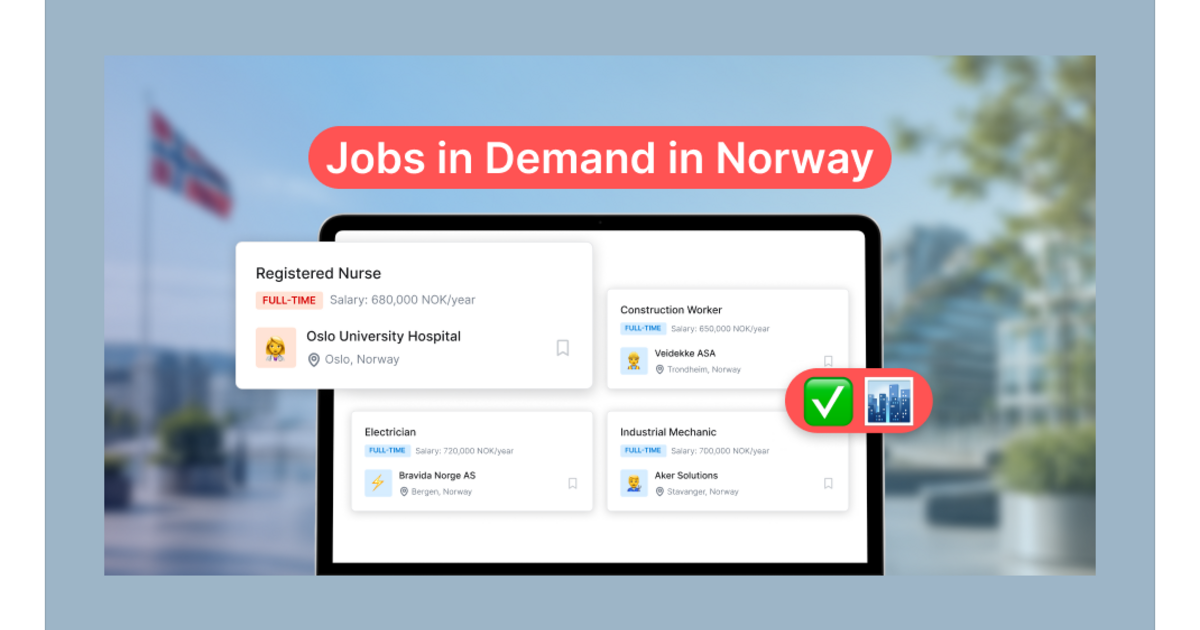
Norway's labor market presents an unusual combination that economists find genuinely interesting. Unemployment stays remarkably low, wages sit among the highest in Europe, and yet employers across entire sectors still can't find enough qualified people to hire. If you're weighing a move to Norway, whether as a skilled professional abroad or a local worker considering a career shift, understanding exactly which jobs are in demand in Norway right now can make the difference between a straightforward relocation and months of frustrated job searching.
Why Norway Has So Many Unfilled Jobs
Norway's shortage isn't a temporary blip caused by a single economic event. It's structural, meaning it's built into the country's demographics and won't resolve itself without sustained effort. An aging population is retiring faster than younger workers can replace them, birth rates sit below replacement level, and several industries, particularly energy and healthcare, are expanding at the same time their most experienced staff are heading toward retirement.
NAV, the Norwegian Labour and Welfare Administration, runs an annual business survey that puts hard numbers on this problem. Recent findings point to a national shortage exceeding 39,000 workers, with health and social services alone accounting for over 11,000 of those unfilled positions, and skilled trades such as carpenters, electricians, plumbers, and welders responsible for close to 17,000 more. These aren't niche gaps affecting a handful of small employers. They're widespread shortages touching hospitals, construction sites, schools, and factories across the country.
Because the problem is so persistent, Norway has responded by actively courting foreign talent. UDI, the Directorate of Immigration, maintains a shortage occupation list covering more than 190 roles that qualify for expedited visa processing, a strong signal of exactly where the government wants to see more skilled applicants. You can browse the current list and eligibility details directly on the UDI website.
Healthcare Tops the List
If there's one sector where Norway's need is impossible to overstate, it's healthcare. Registered nurses, doctors, care assistants, and mental health professionals are urgently needed to keep pace with an aging population that requires more medical attention every year. Some projections suggest the nursing shortage alone could stretch into the thousands by the end of the decade, with rural and northern regions feeling the pinch most acutely since fewer professionals want to relocate away from Oslo or Bergen.
It's worth being upfront about one thing here. Unlike tech roles, healthcare positions in Norway generally require solid Norwegian language proficiency, often at B1 to C1 level, since patient communication simply can't happen in English at a hospital bedside. That makes healthcare a longer runway for foreign applicants compared to some other in-demand fields, but the payoff is a genuinely secure, well-respected career path with strong long-term demand.
Skilled Trades and Construction
Norway's construction sector has quietly become one of the country's most acute shortage areas. Building and related trades workers, excluding electricians, showed the highest incidence of shortage occupations of any category tracked by EURES in recent labor market reports. Carpenters, plumbers, welders, and industrial mechanics holding a fagbrev, Norway's formal trade certificate, are especially sought after, with mechanical and machine trades registering some of the deepest gaps in NAV's most recent survey.
This demand is being driven by a mix of factors, including major infrastructure projects, ongoing housing construction, and the continued build-out of offshore energy installations. For someone with a recognized trade qualification and a willingness to learn workplace Norwegian, construction offers a relatively fast track into steady, well-paid employment, since many of these positions don't require the extended language fluency that healthcare or teaching roles demand.
Technology and IT Roles
Technology remains one of the most accessible sectors for English-speaking foreign workers, and it's easy to see why. An estimated 80 to 90 percent of Norwegian tech jobs operate primarily in English, particularly in Oslo's growing startup scene and within multinational companies with Nordic offices. Software developers, data scientists, cybersecurity specialists, and data engineers all appear consistently on shortage lists, and demand shows no signs of slowing as Norway continues investing heavily in digital infrastructure and, more recently, national AI research initiatives.
Companies like Kongsberg Gruppen, which builds advanced defense, maritime, and aerospace technology, illustrate how deeply tech skills are woven into Norway's traditional industrial base, not just its startup culture. If you're a developer or data professional weighing your options abroad, Norway's combination of English-friendly workplaces and genuine, sustained hiring need makes it one of the more approachable markets in Europe.
Engineering Across Every Discipline
Engineering shortages run wide and deep in Norway, touching civil, mechanical, electrical, and petroleum disciplines alike. Science and engineering professionals ranked among the occupational groups with the highest shortage occurrence in recent EURES labor market data, and NHO's own skills survey of over 5,000 member companies found that more than half struggled to recruit qualified engineering and technical staff.
Civil engineers are needed for public infrastructure and housing projects, mechanical engineers for the country's substantial industrial base, and electrical and petroleum engineers for both traditional oil and gas operations and the growing renewable energy sector. Norway's continued investment in offshore wind and green energy transition means this demand is likely to intensify over the next decade rather than fade.
Energy, Both Old and New
Oil and gas hasn't disappeared from Norway's employment picture, but it now sits alongside a rapidly growing renewable energy sector, and both are hungry for skilled workers. Technicians, offshore operators, and specialized engineers remain in high demand for North Sea operations, while a parallel wave of hiring is happening in wind, hydro, and other renewable projects as Norway pushes toward its climate goals.
For workers with offshore or energy sector experience, this dual demand creates unusual flexibility. Skills built in traditional oil and gas roles often transfer reasonably well into renewable energy positions, giving experienced professionals more career options than a narrower single-sector market would offer.
Logistics, Teaching, and Other Growing Fields
A handful of other sectors round out Norway's demand picture without necessarily grabbing headlines. Logistics and transportation, including truck drivers, warehouse staff, and logistics coordinators, remain essential for keeping trade and industrial supply chains moving. Teaching professionals also appeared among the occupational groups facing the highest shortage occurrence in recent EURES reporting, a reminder that not every in-demand job sits in engineering or tech. Finance and accounting roles, particularly in Oslo where many multinational companies base their Nordic operations, continue to see steady demand for financial analysts, accountants, and auditors familiar with cross-border compliance.
How to Actually Land One of These Jobs
Knowing which occupations are in demand is only half the equation. Getting hired into one requires a realistic strategy. Start by searching established platforms such as NAV, EURES, and LinkedIn, since these consistently surface the widest range of Norwegian employer postings, including those explicitly open to international candidates. From there, check whether your target role appears on UDI's shortage occupation list, because that status can meaningfully speed up your visa processing once you have a job offer in hand.
It also helps to be honest with yourself about language. IT and engineering roles at larger companies often run smoothly in English, but healthcare, education, and most customer-facing public sector jobs genuinely require solid Norwegian, and pretending otherwise tends to backfire during interviews. Non-EEA nationals will need to secure a skilled worker residence permit through UDI before starting employment, while EU and EEA citizens can work in Norway without that additional step, giving them a meaningfully faster path into the market. For a full overview of current labour market conditions and monthly unemployment figures, NAV's labour market information page is the most reliable official source.
Frequently Asked Questions
What are the most in-demand jobs in Norway right now?
Healthcare roles like nurses and doctors, skilled trades such as electricians and welders, software developers and cybersecurity specialists, and engineers across civil, mechanical, and petroleum disciplines all rank among Norway's most persistent shortage occupations.
Do I need to speak Norwegian to get a job in Norway?
It depends heavily on the sector. Many technology and multinational corporate roles operate primarily in English, while healthcare, teaching, and most public-facing jobs typically require Norwegian proficiency at B1 level or higher.
Is it easier for foreigners to get a visa for shortage occupations?
Yes. UDI maintains an official shortage occupation list covering more than 190 roles that qualify for faster, more streamlined visa processing compared to standard skilled worker applications.
Which Norwegian city has the most job opportunities?
Oslo remains the primary hub for finance, technology, and consulting roles, while Stavanger leads in oil, gas, and offshore engineering, and Bergen offers strong opportunities in maritime industries, fishing, and logistics.
Do EU citizens need a work permit to work in Norway?
No. EU and EEA citizens can work freely in Norway without a separate work permit, while non-EEA nationals must obtain a skilled worker residence permit through UDI before beginning employment.
Where can I find official Norwegian job vacancy data?
NAV publishes regularly updated labor market statistics and vacancy figures, and EURES offers a broader European comparison of shortage and surplus occupations across member countries.
Norway's labor shortage, frustrating as it clearly is for employers, translates into genuine opportunity for the right candidates. Whether your background is in nursing, software development, skilled trades, or engineering, the country's demographic reality means demand for qualified workers isn't going away anytime soon, and understanding exactly where that demand concentrates puts you several steps ahead of anyone job hunting blind.
Har du lyst til å lære mer norsk?
Meld deg på i dag og lær norsk på nettet med vårt spillbaserte språkkurs «Samanehs reise», fra nybegynnernivå til flytende nivå!
415 kr per month