How Long Does It Take to Learn Norwegian? A1 to B2 Timeline Explained
How long does it take to learn Norwegian? There is no single answer because it depends on your starting point, how often you study, how much Norwegian you use outside your lessons, and what level you want to reach
For a beginner who studies consistently, reaching basic conversational Norwegian can take a few months. Reaching B1 or B2 usually requires significantly more time and regular practice.
As a general guideline, someone following a structured and intensive learning plan could progress from A1 to B2 in around 12 months. With a more relaxed part-time schedule, the same journey could take considerably longer.
Lingu's Norwegian course catalogue currently includes learning options from A1 through B2 and C1, including self-study, flexible live classes, and the more intensive Fast-Track Norwegian programme.
The important thing is not simply how many months you study. The number of hours you actively spend learning and using Norwegian matters much more.
How long does it take to learn Norwegian?
For a complete beginner, a realistic timeline might look like this:
|
Level |
Approximate time |
What you can generally do |
|
A1 |
2–3 months |
Introduce yourself and handle very basic situations |
|
A2 |
2–3 additional months |
Manage simple everyday conversations |
|
B1 |
3–5 additional months |
Communicate independently about familiar topics |
|
B2 |
3–5 additional months |
Communicate confidently in more complex situations |
These are estimates rather than fixed deadlines.
For example, Lingu's Fast-Track Norwegian programme gives an approximate structure of 2 months for A1, 2 months for A2, 4 months for B1, and 4 months for B2. The programme notes that progress depends on factors such as regular attendance, homework, use of the learning platform, and additional practice.
That gives a structured A1-to-B2 pathway of approximately 12 months.
Someone studying only a few hours per week may need considerably longer.
What do A1, A2, B1 and B2 actually mean?
The CEFR system divides language ability into six main levels, from A1 to C2.
For Norwegian learners, the levels most commonly discussed when moving to Norway are A1, A2, B1 and B2.
The official Norwegian language test, Norskprøven, measures Norwegian skills from A1 through B2. It tests four different skills: listening, reading, writing and speaking.
A1: Basic Norwegian
A1 is the first level.
At this stage, you can understand and use very basic expressions and communicate about familiar things.
You should be able to do things such as:
-
Introduce yourself
-
Say where you come from
-
Talk about your family
-
Order simple food
-
Ask basic questions
-
Understand simple instructions
-
Talk about basic daily routines
You will still need people to speak relatively slowly and clearly.
According to HK-dir's description of the Norwegian levels, A1 is the level at which learners can understand and use familiar everyday expressions and very simple statements.
How long does it take to reach A1 Norwegian?
For a complete beginner studying consistently, around 2–3 months is a reasonable target with a structured course and regular independent practice.
However, this can vary significantly.
Someone studying Norwegian for 30–60 minutes every day may progress faster than someone attending one lesson per week but doing little outside the classroom.
At A1, consistency is particularly important because you are building your basic vocabulary, pronunciation, grammar and sentence patterns.
A2: Everyday Norwegian
A2 is where Norwegian becomes considerably more useful in everyday life.
At A2, you can understand simple language and participate in conversations about familiar practical topics.
You can talk about:
-
Your job
-
Your home
-
Shopping
-
Food
-
Family
-
Transport
-
Appointments
-
Hobbies
-
Everyday routines
You can also read short, simple texts and write basic messages.
HK-dir describes A2 as the level where learners can participate in simple conversations about practical tasks and routine work processes in familiar situations.
How long does it take to reach A2 Norwegian?
For many learners, A2 can take another 2–3 months after A1 with regular study.
This means a motivated learner following an intensive programme could potentially reach A2 in around 4–6 months from the beginning.
This is also the stage where many learners begin to notice a major difference in everyday life.
You can start understanding simple conversations in shops, cafés, workplaces and public services without translating every sentence in your head.
B1: Independent Norwegian
B1 is an important milestone.
You are no longer limited to very simple conversations. You can communicate more independently about work, education, leisure, experiences and familiar current topics.
At B1, you should be able to:
-
Explain your opinions
-
Describe experiences
-
Tell stories
-
Discuss familiar problems
-
Participate in workplace conversations
-
Understand the main points of clear Norwegian
-
Write connected texts about familiar subjects
According to HK-dir's official description of B1, B1 learners can understand relatively clear and simple language and express themselves understandably and coherently about areas such as work, education and leisure.
How long does it take to reach B1 Norwegian?
Reaching B1 generally takes noticeably longer than reaching A1 or A2.
A realistic estimate for a learner starting from zero is around 7–9 months in total with consistent, structured study.
This is where many learners experience a slowdown.
The reason is simple: moving from basic communication to independent communication requires a much larger vocabulary, better listening comprehension, more grammatical accuracy and considerably more speaking practice.
You may know the grammar but still struggle to understand native speakers.
Or you may understand conversations but find it difficult to express complicated ideas yourself.
That is completely normal.
B2: Confident Norwegian
B2 is an advanced independent level and is often an important goal for people who want to use Norwegian professionally.
At B2, you should be able to participate in conversations with considerably less support from the other person.
You can discuss more complex topics, explain arguments, understand longer texts, and communicate in professional situations.
B2 can be particularly useful if you want to work in an environment where Norwegian is the main language.
It is also one of the levels measured by the official Norskprøven.
The official Norskprøven information from HK-dir explains that the exam measures communicative competence at A1, A2, B1 and B2 across listening, reading, writing and speaking.
How long does it take to reach B2 Norwegian?
For a complete beginner studying intensively, around 12 months can be a realistic structured target for reaching B2.
However, this does not mean everyone will reach B2 in exactly one year.
For some learners, it may take 12–18 months. For others, particularly those studying less frequently or using Norwegian very little outside lessons, it can take considerably longer.
B2 is a substantial jump from basic Norwegian.
You need to move beyond simply knowing more words and develop the ability to use Norwegian flexibly and accurately.
How many hours does it take to learn Norwegian?
Instead of asking only how many months it takes, it can be more useful to think about total study time.
There is no official number of hours that guarantees a particular CEFR level in Norwegian.
A rough planning model for a consistent learner could look like this:
|
Level |
Approximate cumulative study time |
|
A1 |
100–150 hours |
|
A2 |
200–300 hours |
|
B1 |
400–600 hours |
|
B2 |
600–800+ hours |
These figures should be treated as planning estimates, not official Norwegian requirements.
Two people can spend the same number of hours studying and achieve very different results.
Someone who spends an hour actively speaking Norwegian may progress differently from someone who spends an hour passively watching videos.
The quality of practice matters.
How long does it take to learn Norwegian if you study 1 hour a day?
One hour per day gives you approximately 365 hours per year.
That is a significant amount of study time.
With one focused hour every day, plus opportunities to use Norwegian in real life, you could potentially progress through the early levels relatively quickly.
A possible progression might look like:
Months 1–3: A1
Months 4–6: A2
Months 7–10: B1
Months 11–16+: B2
This is only a model. Your actual progress will depend on your previous language experience, learning method and how much Norwegian you use outside your study sessions.
How long does it take to learn Norwegian if you study 30 minutes a day?
Thirty minutes every day gives you around 180 hours per year.
That is still enough to make meaningful progress.
The main advantage is consistency.
Thirty minutes every day is usually more useful for language development than studying for three hours once every two weeks.
With this schedule, however, reaching B2 from zero will generally take longer than with an intensive programme.
A realistic goal might be to focus first on reaching A1 and A2, then gradually increase your exposure to Norwegian as your confidence grows.
Intensive vs part-time Norwegian learning
Your weekly study schedule can make a major difference.
Intensive learning
An intensive learner might:
-
Attend several live lessons each week
-
Study Norwegian independently every day
-
Practise speaking several times per week
-
Complete homework
-
Listen to Norwegian outside class
-
Read Norwegian regularly
-
Use Norwegian in everyday situations
This can accelerate progress considerably.
Lingu's Fast-Track Norwegian combines regular live classes, flexible additional classes and access to an interactive self-study platform. The programme is designed to take learners through the levels with a structured learning path.
Part-time learning
A part-time learner might study:
-
2–3 lessons per week
-
30–60 minutes independently on most days
-
Norwegian occasionally outside class
This is a more manageable option for people who work full-time or have family responsibilities.
The trade-off is that reaching B2 will usually take longer.
There is nothing wrong with a slower timeline if it is the schedule you can actually maintain.
Self-study vs taking a Norwegian course
Another important factor when asking how long it takes to learn Norwegian is how you study.
Self-study can work very well, particularly for vocabulary, grammar, reading and listening.
The problem is that many learners eventually reach a point where they understand Norwegian much better than they can speak it.
That is why speaking practice is important.
A structured course can provide:
-
A clear learning sequence
-
Regular speaking practice
-
Teacher feedback
-
Accountability
-
Opportunities to ask questions
-
Interaction with other learners
For learners who prefer independent study, Lingu's Easy Norwegian provides an online self-study format with access to an interactive learning platform.
For learners who want more flexibility with live lessons, Flexi Norwegian combines live drop-in classes with online self-study.
The best approach is often not simply choosing between self-study and lessons. Combining structured learning with independent practice gives you opportunities to develop all four skills.
Why speaking Norwegian makes you progress faster
One of the biggest mistakes Norwegian learners make is waiting until they feel “ready” before speaking.
You don't need to wait.
You will make mistakes.
That's part of learning.
Try using Norwegian when:
-
Ordering coffee
-
Shopping
-
Talking to colleagues
-
Speaking to neighbours
-
Making appointments
-
Asking for directions
-
Talking to classmates
-
Joining social activities
Even short conversations give your brain a chance to retrieve vocabulary and grammar in real time.
This is very different from recognising the same words in an app or textbook.
How long does it take to learn Norwegian for work?
This depends on the job.
You may be able to work in Norway with relatively limited Norwegian if your workplace operates mainly in English.
However, jobs involving regular communication with Norwegian-speaking colleagues, customers, patients or clients generally require stronger language skills.
A2 can help with basic workplace communication.
B1 can make it easier to handle many everyday professional situations independently.
B2 provides a much stronger foundation for complex workplace communication.
If finding a job is your main goal, you can also read Lingu's guide on how to find a job in Norway as a foreigner.
The important thing is to look at the language requirements for your specific profession rather than assuming that one level is sufficient for every job.
How long does it take to prepare for Norskprøven?
Learning Norwegian and preparing for Norskprøven are related but not the same thing.
The official Norskprøven tests four skills:
-
Listening
-
Reading
-
Writing
-
Speaking
According to HK-dir, the exam measures communicative competence rather than knowledge of a specific syllabus.
This means that simply studying grammar is not enough.
You need to practise the actual skills tested in the exam.
For example, someone may have good conversational Norwegian but struggle with the writing section.
Another learner may understand written Norwegian well but find the speaking test difficult.
If Norskprøven is your goal, it makes sense to include exam-specific practice once you have developed the underlying language skills.
Lingu also offers Norskprøven preparation, with practice for reading, listening, writing and the different levels of the exam.
Can you learn Norwegian in one year?
Yes, it is possible to make substantial progress in one year, particularly if you study consistently and use Norwegian actively.
Reaching B2 from zero within a year is an ambitious target, but a structured programme can make it possible for some learners.
The biggest difference is usually not talent.
It is exposure and consistency.
Someone who studies Norwegian for several hours every week, speaks regularly, listens to Norwegian every day and uses the language at work or in everyday life will have many more opportunities to improve than someone who attends one lesson per week and rarely uses Norwegian outside class.
Why some people learn Norwegian faster than others
Several factors can affect how quickly you progress.
Your previous language experience
If you already speak a Germanic language such as English or German, you may recognise some vocabulary and language structures.
If you speak another Scandinavian language, the similarities can be even more noticeable.
How much time you study
This is obvious but important.
More meaningful exposure generally creates more opportunities to learn.
How often you speak
Speaking forces you to actively retrieve what you know.
Your environment
Living and working in Norway can give you many opportunities to encounter Norwegian.
However, simply living in Norway does not automatically make you fluent. If you spend most of your time communicating in English, you still need deliberate Norwegian practice.
Your learning method
A combination of lessons, self-study, speaking, listening, reading and writing generally gives you more balanced development than relying on one method.
Your goals
Someone who wants to order food and have simple conversations does not need the same level of Norwegian as someone who wants to write professional reports in Norwegian.
A realistic A1 to B2 Norwegian timeline
If you want a simple roadmap, you could use this as a starting point:
Months 1–2: A1
Focus on:
-
Basic vocabulary
-
Pronunciation
-
Present tense
-
Basic sentence structure
-
Introductions
-
Numbers and dates
-
Everyday expressions
Months 3–4: A2
Focus on:
-
Everyday conversations
-
Past and future
-
Practical vocabulary
-
Describing experiences
-
Basic workplace communication
-
Listening comprehension
Months 5–8: B1
Focus on:
-
Speaking more spontaneously
-
Explaining opinions
-
Longer conversations
-
Workplace Norwegian
-
Reading authentic material
-
Writing connected texts
Months 9–12+: B2
Focus on:
-
Complex conversations
-
Professional vocabulary
-
Nuanced communication
-
Longer written texts
-
More natural pronunciation and fluency
-
Norskprøven preparation if required
This timeline is ambitious rather than universal. Some learners will move faster, while others will need more time.
How to make learning Norwegian faster
If you want to reduce the time it takes to reach your target level, focus on consistency rather than trying to find a “perfect” learning method.
Study Norwegian regularly.
Speak from the beginning.
Listen to Norwegian every day.
Review vocabulary instead of constantly learning new words.
Write short texts and get feedback.
Use Norwegian in real situations whenever possible.
And most importantly, don't spend all your study time learning about Norwegian.
Spend time actually using Norwegian.
FAQ: How long does it take to learn Norwegian?
How long does it take to learn Norwegian from zero?
For a motivated learner following a structured programme, reaching A1 can take around 2–3 months, A2 around 4–6 months, B1 around 7–9 months, and B2 around 12 months or longer. These are approximate timelines rather than official requirements.
Is Norwegian easy to learn?
Norwegian is often considered relatively accessible for English speakers because of similarities in vocabulary and sentence structure. However, listening comprehension, pronunciation, dialects and speaking fluently can still take significant practice.
Can I learn Norwegian in 6 months?
Yes. Six months of consistent study can be enough to reach A2 for some learners and potentially begin approaching B1 with intensive practice. Your result will depend heavily on your study schedule and exposure to Norwegian.
Can I reach B2 Norwegian in one year?
It is possible for some learners, particularly with intensive, structured study and substantial exposure to Norwegian. It should be treated as an ambitious target rather than a guaranteed timeline.
How many hours a day should I study Norwegian?
There is no universal requirement. Even 30 minutes every day can produce meaningful progress. If you want to progress quickly, combining regular lessons with 1–2 hours of additional practice can provide much more exposure.
How long does it take to learn Norwegian for work?
It depends on the job. A2 may be sufficient for some basic workplace situations, while B1 or B2 may be more appropriate for jobs requiring frequent and complex communication in Norwegian.
How long does it take to reach B2 Norwegian?
A complete beginner following an intensive learning plan might reach B2 in approximately 12 months, while part-time learners may need 18 months or more.
Do I need B2 to pass Norskprøven?
No. Norskprøven A1–B2 measures several CEFR levels, and the specific level you need depends on your goal. The official HK-dir information about Norskprøven explains how the A1–B2 test is structured.
Final thoughts
So, how long does it take to learn Norwegian?
For a complete beginner, a useful planning estimate is:
A1: around 2–3 months
A2: around 4–6 months total
B1: around 7–9 months total
B2: around 12 months or longer
But the timeline matters less than the habits behind it.
Studying Norwegian for a short period every day, speaking regularly, listening to the language and getting feedback can produce much better results than studying intensively for a few weeks and then stopping.
If your goal is to live and work in Norway, don't wait until you are fluent before using Norwegian. Start with simple conversations, gradually increase the difficulty, and build your skills step by step.
With a clear plan and consistent practice, reaching a useful level of Norwegian is a realistic long-term goal
Would you like to learn more Norwegian?
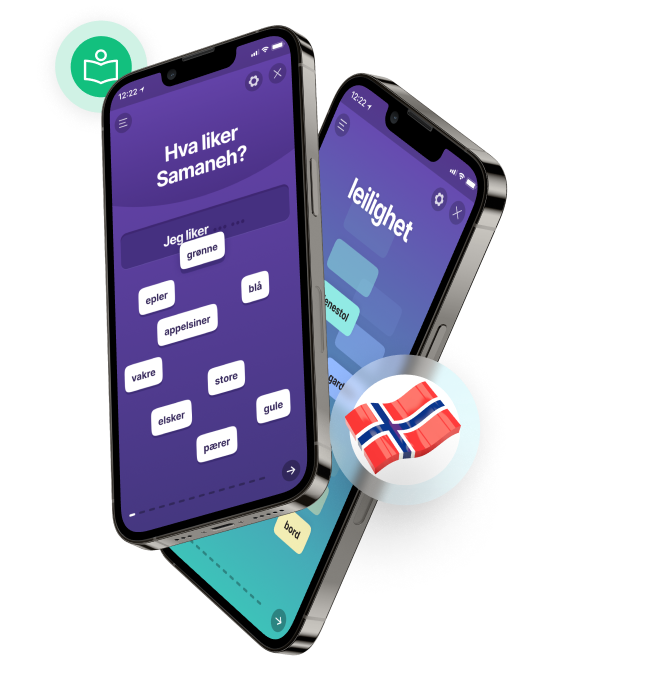
Sign up today and learn Norwegian with our game-based online language course «Samanehs reise», from beginner level to fluent speaker!
NOK 415 per month