How to Prepare for Norskprøven Reading, Listening and Writing - Complete Guide
In this guide, we explain how to prepare effectively for Norskprøven reading, listening and writing, what to practise at each level, what mistakes to avoid and how to use structured Norskprøven preparation to improve your chances of achieving your target result.
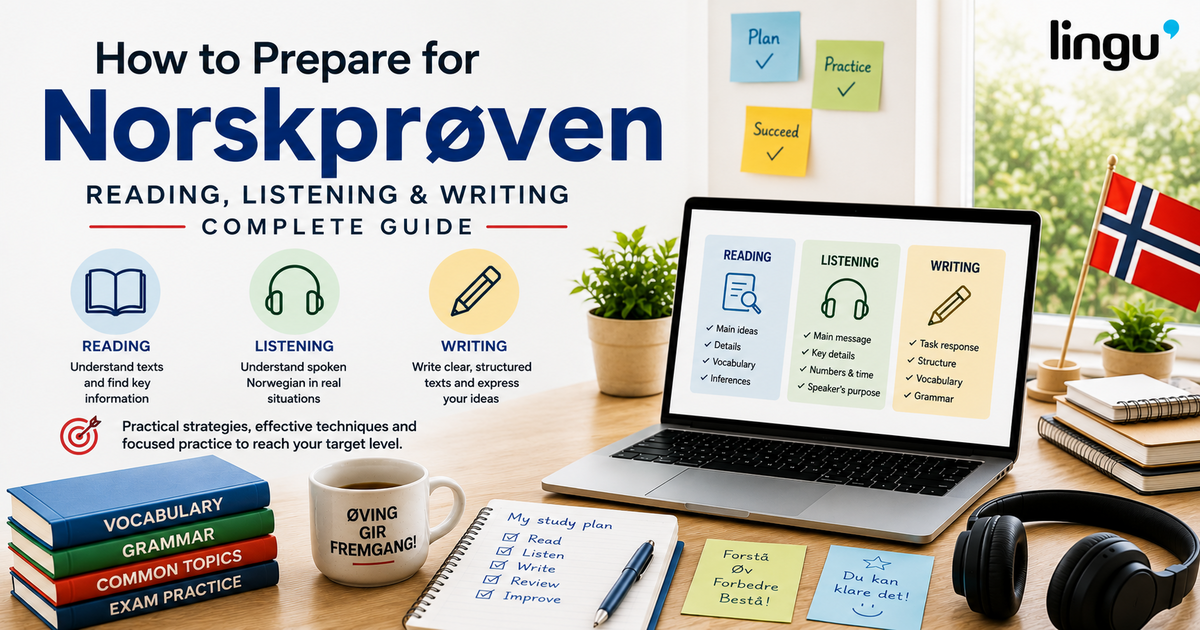
Preparing for Norskprøven is not only about learning more Norwegian. You also need to understand what is expected in the reading, listening and writing sections, identify your weaker skills and practise them in a structured way at the level you want to achieve.
The best preparation therefore combines:
-
Norwegian language development
-
Practice specifically designed for reading, listening and writing
-
Vocabulary and grammar at your target level
-
Familiarity with Norskprøven-style tasks
-
Understanding of the assessment criteria
-
Regular feedback on your progress
If you want to bring all of these areas together in one place, Lingu's Preparation for the Norwegian Language Test is designed specifically for the reading, listening and writing parts of Norskprøven at A1, A2, B1 and B2 level.
You receive six months of access to structured digital preparation that you can complete online and at your own pace. The programme combines exam-relevant practice with vocabulary, grammar, common topics, pronunciation, assessment criteria and personalised feedback from both an AI tutor and a teacher.
What are the reading, listening and writing parts of Norskprøven?
Norskprøven is the official Norwegian Language Test used to assess Norwegian proficiency from A1 to B2.
It consists of four separate parts:
-
Reading - leseprøven
-
Listening - lytteprøven
-
Writing - skriveprøven
The reading, listening and writing sections test different language abilities:
-
Reading measures how well you understand written Norwegian.
-
Listening measures how well you understand spoken Norwegian.
-
Writing measures how well you can communicate your own ideas in written Norwegian.
Because these abilities develop differently, strong Norskprøven preparation should not treat them as one single skill.
You may understand Norwegian texts well but find spoken Norwegian difficult. You may understand both reading and listening but struggle to express your ideas clearly in writing.
This is why Lingu's Preparation for the Norwegian Language Test divides your preparation into targeted reading, listening and writing practice while also helping you develop the vocabulary, grammar and language knowledge needed at your target level.
How should I prepare for Norskprøven reading, listening and writing?
The most effective approach is to combine four areas of preparation.
1. Understand what Norskprøven expects
Before practising, you need to understand the test structure and what language ability is expected at your target level.
Lingu's Preparation for the Norwegian Language Test begins by helping you understand Norskprøven, the different sections and the assessment expectations at A1, A2, B1 or B2.
This gives your preparation a purpose. Instead of simply "studying Norwegian", you know which abilities you are trying to develop.
2. Practise each exam skill separately
Reading, listening and writing require different strategies.
You therefore need dedicated practice in all three areas rather than relying only on general Norwegian exercises.
Lingu provides structured practice specifically for:
-
Reading comprehension
-
Listening comprehension
-
Writing
-
Relevant Norskprøven tasks
3. Develop the language behind the test
Exam technique alone cannot replace Norwegian proficiency.
To perform well, you also need vocabulary, grammar and the ability to understand and communicate about different topics.
For this reason, the programme combines Norskprøven-specific practice with vocabulary, grammar, common topics and pronunciation work adapted to your level.
4. Use feedback to identify what needs improvement
It can be difficult to recognise your own weaknesses, particularly in writing.
Lingu combines feedback from an AI tutor with personalised teacher feedback so that you can identify recurring problems and understand what to work on next.
HK-dir's official sample tasks can also be useful for becoming familiar with the official task format. However, sample tasks alone do not provide a complete preparation programme or ongoing feedback.
A useful strategy is therefore to use structured preparation as your main learning process and official HK-dir examples as an additional way to familiarise yourself with the test.
How to prepare for the Norskprøven reading test
The Norskprøven reading test measures how well you understand written Norwegian.
The official reading test lasts 75 minutes, and the texts and tasks vary in difficulty depending on the level being assessed.
Good reading preparation is therefore about more than simply reading Norwegian.
You need to learn how to:
-
Understand the main message quickly
-
Find specific information
-
Distinguish important information from less important details
-
Understand meaning from context
-
Recognise opinions, reasons and contrasts
-
Work efficiently without translating every word
Lingu's Preparation for the Norwegian Language Test includes dedicated reading comprehension practice for A1, A2, B1 and B2, allowing you to develop these skills at the level you are preparing for.
What should I practise for Norskprøven reading?
Expose yourself to different types of Norwegian texts.
Depending on your level, these can include:
-
Emails
-
Messages
-
Notices
-
Advertisements
-
Instructions
-
Workplace information
-
Public information
-
News articles
-
Short factual texts
-
Longer and more complex texts
After reading, ask yourself:
-
What is the main point?
-
Who is the text written for?
-
What does the writer want the reader to know or do?
-
Which details are important?
-
Can I understand an unfamiliar word from the surrounding context?
-
What is the writer's opinion or intention?
In Lingu's preparation programme, reading is not studied in isolation. You also develop vocabulary and grammar relevant to your target level, which can make increasingly complex texts easier to understand.
Should I read every word carefully in the Norskprøven reading test?
Not necessarily.
Good readers change strategy depending on what they need to find. Sometimes you need to understand the overall message. Sometimes you need one particular detail. Sometimes you need to compare several pieces of information carefully.
Two important reading strategies are:
-
Skimming - reading relatively quickly to understand the general meaning.
-
Scanning - looking through a text for specific information.
You should practise both.
Structured reading practice can help you learn when to read quickly and when a task requires closer attention.
How can I improve my Norwegian reading comprehension?
Reading improves when you regularly work with material that is challenging enough to develop your language but not so difficult that every sentence needs translation.
A useful method is:
-
Read the text once without using a dictionary.
-
Identify the main message.
-
Read the text again more carefully.
-
Identify important unfamiliar vocabulary.
-
Use context before looking words up.
-
Summarise the text in your own Norwegian.
-
Complete questions or exercises connected to the text.
This is particularly useful because reading, vocabulary and active language development reinforce each other.
In Preparation for the Norwegian Language Test, reading comprehension is combined with level-specific vocabulary, grammar and common topics so that you develop the wider language skills needed to understand Norwegian texts more independently.
How to prepare for the Norskprøven listening test
The Norskprøven listening test measures how well you understand spoken Norwegian.
The official listening test takes approximately 30-60 minutes, depending on the version of the test you receive. The tasks reflect spoken Norwegian used in situations outside the classroom. That means listening preparation should not consist only of slow, carefully pronounced educational recordings. You need to become increasingly comfortable processing Norwegian as it is spoken.
Lingu's Preparation for the Norwegian Language Test includes dedicated listening comprehension exercises at A1, A2, B1 and B2, helping you practise at the level you want to achieve.
What should I listen to before Norskprøven?
Try to expose yourself to Norwegian frequently.
Useful listening material includes:
-
Everyday conversations
-
Podcasts
-
News
-
Radio
-
Television
-
Interviews
-
Videos
-
Norwegian learning materials
-
Workplace conversations
-
Public announcements
-
Informal spoken Norwegian
But simply playing Norwegian in the background is not always enough.
Active listening is more effective. After listening, ask yourself:
-
Who is speaking?
-
What is happening?
-
What is the main message?
-
What information is important?
-
What does the speaker want?
-
What opinion is being expressed?
-
Which details did I understand?
-
Which details did I miss?
How can I improve my Norwegian listening comprehension?
A useful listening method has several stages.
First listening
-
Listen without stopping.
-
Do not try to translate every sentence.
-
Focus on the overall situation and main message.
Second listening
-
Listen for details.
Pay attention to things such as:
-
Times
-
Numbers
-
Places
-
Reasons
-
Opinions
-
Instructions
-
Contrasts
-
Actions
Review
Check important vocabulary or supporting material if needed.
Then listen again.
This helps train your brain to recognise Norwegian directly as spoken language rather than constantly translating it into another language.
Lingu's listening activities provide a structured way to practise comprehension rather than leaving you to search randomly for suitable material.
Do I need to understand every word in the Norskprøven listening test?
No. This is one of the most important skills to develop before the test.
You can understand a conversation or message without understanding every individual word. If you hear one expression you do not recognise, do not stop mentally and try to solve it while the recording continues.
Keep listening. Focus on:
-
Context
-
Key words
-
Tone
-
Numbers
-
Times
-
Places
-
Reasons
-
Contrasts
-
The speaker's intention
Structured listening practice can help you become more comfortable with incomplete understanding and train you to identify the information that actually matters.
How to prepare for the Norskprøven writing test
The Norskprøven writing test is different from reading and listening because you have to produce the language yourself. Understanding Norwegian does not automatically mean that you can write it at the same level.
To become a stronger writer, you need to write regularly and receive useful feedback on what you produce. This is one area where Preparation for the Norwegian Language Test can be particularly useful because the programme combines writing practice with feedback from an AI tutor and a teacher.
Instead of only completing writing exercises and wondering whether your answer was good enough, you can use feedback to understand where you need to improve.
What should I practise for Norskprøven writing?
Depending on your target level, practise writing for different purposes.
You may need to:
-
Describe
-
Inform
-
Explain
-
Tell about an experience
-
Express an opinion
-
Give reasons
-
Compare
-
Discuss advantages and disadvantages
-
Develop an argument
Do not memorise one perfect text and expect to reproduce it in the exam.
You need enough Norwegian to respond flexibly when you receive a new topic.
Lingu's writing preparation is adapted to A1, A2, B1 and B2 so that you can practise the type and complexity of written language appropriate to your target level.
What is assessed in the Norskprøven writing test?
Your writing is assessed according to the expectations of the relevant language level. In practical terms, important areas include:
-
Whether you answer the task
-
Relevance
-
Communication
-
Structure
-
Coherence
-
Vocabulary
-
Grammar
-
Sentence structure
-
Spelling
-
Ability to connect ideas
-
Ability to demonstrate language appropriate to the target level
This is why understanding the assessment criteria matters. Preparation for the Norwegian Language Test includes the assessment expectations for your level, helping you understand what you are working towards rather than simply writing without a clear benchmark.
How can I improve my Norskprøven writing?
Use a repeatable writing process.
Step 1 - Understand the task
-
Read the instructions carefully.
-
Identify exactly what the question is asking you to do.
Step 2 - Plan
-
Spend a short amount of time deciding what you want to say.
Step 3 - Write
-
Focus first on answering the task and communicating clearly.
Step 4 - Review
Ask yourself:
-
Did I answer every part of the question?
-
Is the text easy to follow?
-
Have I organised my ideas logically?
-
Have I repeated the same words too often?
-
Are there obvious grammar mistakes?
-
Is my word order correct?
-
Are my sentences complete?
-
Have I connected my ideas clearly?
Step 5 - Use feedback
This is one of the most important stages.
If feedback repeatedly identifies the same issue - for example word order, verb forms, limited vocabulary or unclear sentence structure - make that issue part of your next study session.
Preparation for the Norwegian Language Test gives you access to both AI-tutor and teacher feedback, allowing you to turn individual writing exercises into a longer process of improvement.
Why is feedback important when preparing for Norskprøven?
Without feedback, it is easy to repeat the same mistake for weeks without noticing it.
For example, you may consistently:
-
Put words in the wrong order
-
Use only basic vocabulary
-
Forget verb forms
-
Write sentences that are grammatically possible but unnatural
-
Fail to answer every part of a task
-
Produce writing below the complexity expected at your target level
Feedback helps turn practice into learning.
Lingu combines two types of feedback within Preparation for the Norwegian Language Test.
How can AI feedback help with Norskprøven?
AI feedback can support frequent independent practice.
It can help you notice:
-
Recurring grammar problems
-
Vocabulary limitations
-
Sentence structure problems
-
Unclear formulations
-
Patterns in your mistakes
The main advantage is that you can receive guidance while studying independently rather than needing to wait for your next lesson.
But feedback is most useful when you act on it.
Do not simply read a correction.
-
Rewrite the sentence.
-
Correct the text.
-
Try another task.
-
Check whether you make the same mistake again.
Why is teacher feedback still valuable?
A teacher provides a different kind of support.
A qualified teacher can consider your language more broadly and identify priorities that may not be obvious from an individual mistake.
This is particularly useful in writing because several sentences can be technically correct while differing significantly in clarity, naturalness and level.
Lingu therefore combines AI-tutor support with personalised teacher feedback.
The two approaches complement each other: AI makes regular independent feedback possible, while teacher feedback adds human professional guidance to your preparation.
What is expected at A1, A2, B1 and B2?
The Norskprøven levels represent increasingly independent and complex use of Norwegian.
Preparation for the Norwegian Language Test is available separately at A1, A2, B1 and B2, with the learning content, vocabulary, grammar, tasks and assessment expectations adapted to each level.
Norskprøven A1 preparation
At A1, you are developing basic Norwegian for familiar everyday situations.
You work on understanding and communicating simple information using relatively basic vocabulary and structures.
Lingu's A1 preparation allows you to practise reading, listening and writing while developing vocabulary and grammar relevant to beginner-level Norwegian.
Norskprøven A2 preparation
At A2, you need to handle a wider range of everyday communication and familiar topics.
You should become increasingly able to understand straightforward Norwegian and communicate simple information independently.
Preparation for the Norwegian Language Test includes dedicated A2 reading, listening and writing practice together with A2-level vocabulary and grammar.
Norskprøven B1 preparation
At B1, you need to use Norwegian more independently. You should be able to understand the main content of texts and speech on familiar subjects and communicate experiences, opinions and explanations with greater detail.
Lingu's B1 preparation combines exam-relevant reading, listening and writing activities with vocabulary, grammar and assessment criteria appropriate for B1.
Norskprøven B2 preparation
At B2, you need stronger comprehension, a wider vocabulary and greater ability to develop and organise ideas. The language you read, hear and produce becomes more complex.
Lingu's B2 preparation allows you to practise the reading, listening and writing skills expected at this level while strengthening level-appropriate vocabulary, grammar and language use.
How do I know which Norskprøven level to prepare for?
You need to consider two things: your current Norwegian level and the level you need to achieve
If you need B2 but your Norwegian is currently around A2, repeatedly completing B2 tasks will not automatically make you a B2 user of Norwegian. You need to develop the language itself.
This is an important difference between exam practice and exam preparation. Exam practice teaches you about the format. Good exam preparation develops both your Norwegian and your ability to use it in the test.
Because Lingu's programme includes separate content for A1, A2, B1 and B2, you can work with material appropriate to the level you are preparing for rather than relying on generic Norskprøven exercises.
What does Preparation for the Norwegian Language Test include?
Lingu's Preparation for the Norwegian Language Test is an interactive online programme designed specifically for the reading, listening and writing sections of Norskprøven.
It includes preparation at:
-
A1
-
A2
-
B1
-
B2
At each level, you work with:
-
Assessment criteria for your target level
-
Reading comprehension
-
Listening comprehension
-
Writing practice
-
Vocabulary
-
Grammar
-
Common topics
-
Pronunciation
-
Understanding the test structure
-
Exam-relevant practice
You receive six months of access and can complete the programme online at your own pace. The programme also includes support from an AI tutor and a teacher, giving you feedback during your preparation.
How is Lingu's Norskprøven preparation structured?
Each level is organised into five main chapters.
Chapter 1 - Understanding Norskprøven
Learn how the Norwegian Language Test works, what the different sections involve and what is expected at your target level.
Understanding the test before you begin intensive practice makes the rest of your preparation more focused.
Chapter 2 - Practising the exam sections
Work specifically with the three sections covered by the programme:
-
Reading
-
Listening
-
Writing
This helps you develop each skill separately while becoming more comfortable with exam-relevant activities.
Chapter 3 - Common topics
Build vocabulary and practise Norwegian through themes that are relevant for adult language learners and everyday communication.
This helps you become more flexible when you encounter an unfamiliar topic.
Chapter 4 - Grammar
Practise grammar appropriate to A1, A2, B1 or B2.
Instead of learning grammar without context, connect it to the Norwegian you need to understand and produce.
Chapter 5 - Pronunciation
Work with Norwegian vowels, difficult sounds and stress patterns.
Pronunciation may appear surprising in a programme focused on reading, listening and writing, but understanding how Norwegian sounds can also improve your listening comprehension.
Why does reading, listening and writing preparation include pronunciation?
Listening comprehension depends partly on your ability to recognise words when they are spoken. A word you understand immediately on paper can be difficult to recognise when you hear it in natural Norwegian.
Learning more about:
-
Norwegian vowel sounds
-
Difficult sound combinations
-
Stress
-
Pronunciation patterns
can help connect the written language you know with the spoken language you hear.
This makes pronunciation relevant even if you are currently focusing on the listening section rather than the oral test.
How important is vocabulary for Norskprøven?
Vocabulary affects every part of the test.
Vocabulary and reading
A stronger vocabulary helps you understand texts more quickly and makes it easier to infer meaning from context.
Vocabulary and listening
The faster you recognise spoken words, the less likely you are to fall behind while mentally translating.
Vocabulary and writing
A wider active vocabulary allows you to express ideas more accurately and avoid repeating the same simple words.
This is why Preparation for the Norwegian Language Test includes vocabulary work as part of each target level instead of treating reading, listening and writing as isolated exam techniques.
What is the best way to learn vocabulary for Norskprøven?
Avoid learning hundreds of disconnected words without context.
Instead, organise vocabulary around:
-
Topics
-
Meaning
-
Useful phrases
-
Collocations
-
Opposites
-
Word families
-
Real situations
Most importantly, use new vocabulary.
-
Write sentences with it.
-
Use it in writing tasks.
-
Notice it when reading.
-
Listen for it in spoken Norwegian.
Vocabulary becomes much more useful when it moves from something you recognise to something you can actively use.
How important is grammar for Norskprøven?
Grammar helps you understand Norwegian accurately and communicate your own meaning clearly.
But memorising grammar rules alone is not enough. You need to use grammar. For example, if you are working on Norwegian word order, practise it in:
-
Sentences
-
Emails
-
Paragraphs
-
Writing tasks
-
Summaries
-
Opinions
-
Your own examples
The aim is not simply to know the rule. The aim is to use the structure naturally enough that it supports your communication.
Lingu's programme includes grammar adapted to each target level so that you can develop the language structures relevant to the Norwegian you are expected to use.
What grammar should I practise for Norskprøven?
The exact grammar depends on your level, but areas may include:
-
Verb forms
-
Word order
-
Nouns and articles
-
Adjectives
-
Pronouns
-
Prepositions
-
Negation
-
Main clauses
-
Subordinate clauses
-
Sentence connectors
-
Comparative structures
-
More complex sentence patterns at higher levels
Do not try to correct everything at the same time. Use your exercises and feedback to identify which grammar problems occur repeatedly, then work on those areas systematically.
What topics should I prepare for Norskprøven?
Norskprøven measures language proficiency rather than knowledge of a fixed list of factual topics. You therefore cannot memorise a small number of subjects and assume they will appear on your test. However, developing Norwegian through a range of common adult topics can give you the vocabulary and flexibility needed to understand unfamiliar tasks.
Useful themes may include:
-
Family
-
Work
-
Education
-
Housing
-
Health
-
Travel
-
Transport
-
Technology
-
Environment
-
Leisure
-
Everyday services
-
Society
-
Life in Norway
This is why one of the five chapters in Lingu's Preparation for the Norwegian Language Test focuses on common topics and relevant vocabulary.
The goal is not to predict the examination question. The goal is to build enough language to deal with different questions confidently.
What are the most common Norskprøven reading mistakes?
1. Translating every word
This makes reading unnecessarily slow and can distract you from the overall message.
2. Ignoring exactly what the question asks
You may understand the text but still choose the wrong answer if you answer a different question.
3. Getting stuck on unfamiliar vocabulary
Use context and keep reading.
4. Reading everything in the same way
Some tasks require skimming. Others require careful reading.
5. Practising only easy material
If everything feels comfortable, you may not be developing towards the next level. Structured level-specific reading practice helps you gradually work with the type of comprehension expected at your target level.
What are the most common Norskprøven listening mistakes?
1. Panicking after missing one word
You may miss the next important sentence because you are still thinking about the previous word.
2. Translating everything mentally
Spoken language moves too quickly for word-by-word translation to be an effective long-term strategy.
3. Listening only to slow learner Norwegian
You need to become comfortable with more natural spoken Norwegian gradually.
4. Listening passively
Ask questions about what you hear and actively check your understanding.
5. Avoiding difficult listening
Improvement comes from gradually increasing the challenge. Regular listening comprehension practice within a structured programme gives you a clearer progression than simply listening to random Norwegian material.
What are the most common Norskprøven writing mistakes?
1. Not answering the complete task
Always check exactly what the instructions ask you to include.
2. Memorising complete model answers
You cannot predict the exact topic you will receive.
3. Trying to use language that is too complicated
Clear Norwegian you can control is better than extremely advanced sentences full of errors.
4. Repeating the same vocabulary
Work actively on expanding your usable vocabulary.
5. Writing without reviewing
Always leave time to reread your answer.
6. Concentrating only on grammar
Grammar matters, but so do communication, relevance, structure and task completion.
7. Ignoring recurring feedback
If the same problem appears again and again, it needs targeted practice.
This is one of the reasons ongoing feedback can be more useful than completing isolated sample tasks without receiving any individual response.
Is Lingu's Preparation for the Norwegian Language Test better than using free sample tasks?
They serve different purposes. Official sample tasks are useful because they help you see what Norskprøven tasks can look like and become familiar with the official format.
However, sample tasks alone are not a complete learning programme. They do not organise months of preparation for you, systematically develop your vocabulary and grammar or provide ongoing personalised feedback on your language.
Lingu's Preparation for the Norwegian Language Test is designed for the broader preparation process.
You work with:
-
Your target level
-
Reading
-
Listening
-
Writing
-
Vocabulary
-
Grammar
-
Assessment criteria
-
Common topics
-
Pronunciation
-
AI feedback
-
Teacher feedback
A strong approach is therefore to use Lingu for your structured preparation and HK-dir's official examples as an additional reference for official task formats.
Can I use Preparation for the Norwegian Language Test without taking a Norwegian course?
Yes.
The programme is designed for independent digital study. You can use it even if you are not enrolled in a regular Norwegian course. You receive six months of access and decide when and how often you want to study. This makes it particularly useful if you already have a Norwegian foundation and want to focus specifically on preparing for Norskprøven.
However, if your current Norwegian is significantly below the level you need to achieve, broader Norwegian instruction may still be useful alongside exam preparation.
Can I focus on only one weak Norskprøven section?
Yes.
Although Preparation for the Norwegian Language Test covers reading, listening and writing, your preparation does not need to be divided equally between all three. If your reading is already strong but listening is difficult, spend more time on listening.
If you understand Norwegian well but struggle to write at B1 or B2 level, prioritise writing practice, vocabulary, grammar and feedback. The advantage of self-paced preparation is that you can allocate more time to the skill that needs it most.
Can I prepare for Norskprøven online?
Yes.
Preparation for the Norwegian Language Test is completely digital. You receive six months of access and can study online wherever it suits you. This allows you to prepare around work, family, Norwegian classes or other commitments without depending on a fixed class schedule.
You still receive guidance through AI-tutor and teacher feedback, so self-paced study does not have to mean preparing entirely without support.
A realistic Norskprøven reading, listening, and writing study schedule
You do not need to study every section for several hours every day. Consistency and targeted practice are more important.
Here is an example of how you could use Lingu's Preparation for the Norwegian Language Test during one week.
Monday - Reading
Complete reading activities in your Lingu preparation programme.
Pay attention to:
- Main ideas
- Important details
- Purpose
- Vocabulary
- Meaning from context
- Then review vocabulary that caused difficulty.
Tuesday - Listening
- Complete listening comprehension practice.
- Listen for the overall message first and details second.
- Notice which types of information you regularly miss.
- Use additional Norwegian audio during the day if possible.
Wednesday - Writing
- Complete a writing task.
- Use feedback from the AI tutor or teacher to identify your most important areas for improvement.
- Correct or rewrite parts of your response instead of simply moving on to another task.
Thursday - Vocabulary and grammar
- Work with the vocabulary and grammar material for your target level.
- Pay particular attention to language problems identified through your writing or comprehension practice.
Friday - Mixed Norskprøven preparation
- Combine shorter reading, listening and writing activities.
- Focus on applying what you studied earlier in the week.
Weekend - Exam-focused review
- Use the exam-section material in Lingu and, when useful, compare your experience with official HK-dir sample tasks.
- Then ask yourself:
- Which section feels strongest?
- Which section still requires the most effort?
- Which mistakes keep returning?
- What should I prioritise next week?
- This turns your preparation into an ongoing cycle rather than a collection of unrelated exercises.
How long should I prepare for Norskprøven?
There is no single correct number of weeks.
How long you need depends on:
- Your current Norwegian level
- Your target level
- How much Norwegian you use in daily life
- Your reading comprehension
- Your listening comprehension
- Your writing ability
- Your vocabulary
- Your grammar
- How consistently you study
There is also an important difference between preparing for the format of the test and developing to a new CEFR level.
If your Norwegian is already close to your target, structured exam preparation may be your main priority.
If you need to move significantly from A2 towards B1 or from B1 towards B2, you also need to strengthen the underlying language.
This is why Lingu's Preparation for the Norwegian Language Test does more than provide practice tests. It combines exam-relevant preparation with vocabulary, grammar and wider language development at the level you are working towards.
What should I do in the final weeks before Norskprøven?
As the exam approaches, make your preparation increasingly targeted.
For reading
- Practise working efficiently.
- Identify the purpose of each task.
- Work on both general understanding and specific details.
- Review vocabulary that repeatedly causes problems.
For listening
- Listen to Norwegian regularly.
- Practise understanding the overall meaning without translating every word.
- Work with increasingly natural spoken Norwegian.
- Identify the types of information you tend to miss.
For writing
- Complete full writing tasks.
- Use feedback.
- Review your recurring grammar and vocabulary problems.
- Practise planning quickly.
- Practise reviewing your own text before finishing.
For all three sections
- Return to the assessment criteria for your target level.
- Use Lingu's structured preparation to continue developing your skills and use official sample tasks to ensure that the test format feels familiar.
Does Preparation for the Norwegian Language Test include speaking?
No.
Lingu's Preparation for the Norwegian Language Test is specifically designed for:
-
Reading
-
Listening
-
Writing
If you also need to prepare for the oral section, Lingu offers Muntlig, a separate AI-powered Norskprøven preparation tool for speaking practice.
Together, the two products allow you to prepare for all four main language areas:
-
Preparation for the Norwegian Language Test - reading, listening and writing
-
Muntlig - speaking
Is Preparation for the Norwegian Language Test worth using?
If you want more than isolated practice questions, a structured preparation programme can make your study considerably easier to organise.
Instead of deciding every day what to read, what grammar to study, what listening material to find and how to evaluate your writing, Lingu brings the main preparation areas together according to your target level.
You receive:
-
Structured A1, A2, B1 or B2 preparation
-
Reading comprehension practice
-
Listening comprehension practice
-
Writing practice
-
Assessment criteria
-
Vocabulary
-
Grammar
-
Common topics
-
Pronunciation
-
AI-tutor feedback
-
Teacher feedback
-
Six months of online access
-
The flexibility to study at your own pace
For learners who want to prepare independently but still want structure and feedback, this provides a useful middle ground between completely unguided self-study and enrolling in a full Norwegian course.
Final advice: How to prepare effectively for Norskprøven reading, listening and writing
-
Do not prepare for Norskprøven by trying to memorise the exam.
-
Prepare by developing the Norwegian you need to perform well regardless of the exact task you receive.
-
Read regularly.
-
Listen frequently.
-
Write often.
-
Build vocabulary.
-
Improve your grammar.
-
Understand the assessment criteria.
-
Use feedback.
-
Identify your weakest skill.
-
And practise at the level you actually want to achieve.
Official sample tasks are useful for becoming familiar with Norskprøven, but effective preparation requires more than knowing what the test looks like.
Lingu's Preparation for the Norwegian Language Test gives you a structured way to prepare for reading, listening and writing at A1, A2, B1 or B2, with six months of self-paced digital access, exam-relevant practice, vocabulary, grammar, common topics, pronunciation and personalised support from both an AI tutor and a teacher.
Instead of trying to organise your entire Norskprøven preparation yourself, you can follow a programme built specifically around the skills you need for the test.
The goal is not to predict every question. The goal is to arrive at Norskprøven with stronger Norwegian, a clear understanding of what is expected at your level and enough practice to use your language effectively when it matters.
Frequently Asked Questions About Norskprøven Reading, Listening and Writing
What is the best way to prepare for Norskprøven reading?
Combine regular Norwegian reading with structured reading comprehension practice at your target level. Learn to identify main ideas, specific details and meaning from context instead of translating every word.
Lingu's Preparation for the Norwegian Language Test includes dedicated reading preparation for A1, A2, B1 and B2 together with vocabulary and grammar relevant to each level.
What is the best way to prepare for Norskprøven listening?
Listen to Norwegian regularly and practise identifying both the main message and important details without depending on understanding every word.
Preparation for the Norwegian Language Test includes structured listening comprehension practice at A1-B2, while additional exposure to authentic spoken Norwegian can strengthen your listening further.
What is the best way to prepare for Norskprøven writing?
Write regularly, practise different task types and use feedback to identify recurring weaknesses.
Lingu's Preparation for the Norwegian Language Test combines writing practice with personalised AI-tutor and teacher feedback, helping you understand what you need to improve before the test.
What is Preparation for the Norwegian Language Test?
Preparation for the Norwegian Language Test is Lingu's online preparation programme for the reading, listening and writing parts of Norskprøven.
It provides structured digital preparation at A1, A2, B1 and B2 and combines exam-relevant practice with vocabulary, grammar, assessment criteria, common topics, pronunciation and feedback.
Which Norskprøven levels can I prepare for with Lingu?
You can prepare at A1, A2, B1 or B2.
The learning content, vocabulary, grammar, practice tasks and assessment expectations are adapted to the level you are preparing for.
Does Lingu's Norskprøven preparation include reading?
Yes. Reading comprehension is one of the three main sections covered by Preparation for the Norwegian Language Test.
Does Lingu's Norskprøven preparation include listening?
Yes. The programme contains listening comprehension practice appropriate to your target level.
Does Lingu's Norskprøven preparation include writing?
Yes. Writing is one of the core areas of the programme, and you also receive feedback to help you identify areas for improvement.
Does Preparation for the Norwegian Language Test include speaking?
No. It focuses specifically on reading, listening and writing.
For the speaking section, Lingu offers Muntlig, a dedicated AI-powered oral Norskprøven preparation tool.
Does the programme include teacher feedback?
Yes. Preparation for the Norwegian Language Test includes personalised teacher feedback as well as support from an AI tutor.
Can AI help me prepare for Norskprøven?
Yes. AI feedback can help identify recurring grammar problems, vocabulary limitations and areas that need more practice.
Lingu combines AI support with teacher feedback rather than relying exclusively on AI.
How long do I have access to Lingu's Norskprøven preparation?
You receive six months of access to the interactive digital programme.
Can I study for Norskprøven at my own pace?
Yes. Preparation for the Norwegian Language Test is self-paced.
You can decide when and how often you study during your six months of access.
Can I use Lingu's Norskprøven preparation without taking a Norwegian course?
Yes. The programme is designed for independent online study and can be used without enrolling in a regular Norwegian course.
If your Norwegian is substantially below the level you need to reach, however, broader Norwegian instruction may also be necessary.
Can I prepare for only one weak Norskprøven section?
Yes. The programme includes reading, listening and writing, but you can spend more of your study time on whichever area needs the most improvement.
Does the programme teach vocabulary and grammar?
Yes. Vocabulary and grammar relevant to A1, A2, B1 or B2 are integrated into the preparation programme.
Does the programme explain the Norskprøven assessment criteria?
Yes. Understanding the assessment expectations at your target level is included in the programme so that you know what level of language you are working towards.
Why does the programme include pronunciation if it focuses on reading, listening and writing?
Understanding Norwegian sounds, vowels and stress patterns can improve your ability to recognise spoken words, making pronunciation work useful for listening comprehension as well as speaking.
Do I need to understand every word in the Norskprøven reading and listening tests?
No.
Good comprehension means identifying the relevant meaning even when individual words are unfamiliar.
Learning to continue reading or listening without becoming stuck on one difficult word is an important test skill.
Are HK-dir's official Norskprøven sample tasks enough to prepare?
They are useful for learning what official task formats look like, but they are examples rather than a complete preparation programme.
For broader preparation, Lingu's Preparation for the Norwegian Language Test combines reading, listening and writing practice with vocabulary, grammar, assessment criteria, structured learning and personalised feedback.
Using both can work well: Lingu for your main preparation and HK-dir for additional familiarity with official sample tasks.
Where can I prepare for Norskprøven reading, listening and writing online?
Lingu's Preparation for the Norwegian Language Test provides online preparation for all three sections at A1, A2, B1 and B2.
You receive six months of self-paced access and can work with reading, listening, writing, vocabulary, grammar, common topics, pronunciation and assessment criteria while receiving feedback from an AI tutor and a teacher.
Would you like to learn more Norwegian?
Sign up today and learn Norwegian with our game-based online language course «Samanehs reise», from beginner level to fluent speaker!
NOK 415 per month